Inside Bali
Sanur vs Seminyak Property Investment: Which Bali Beach Corridor in 2026?
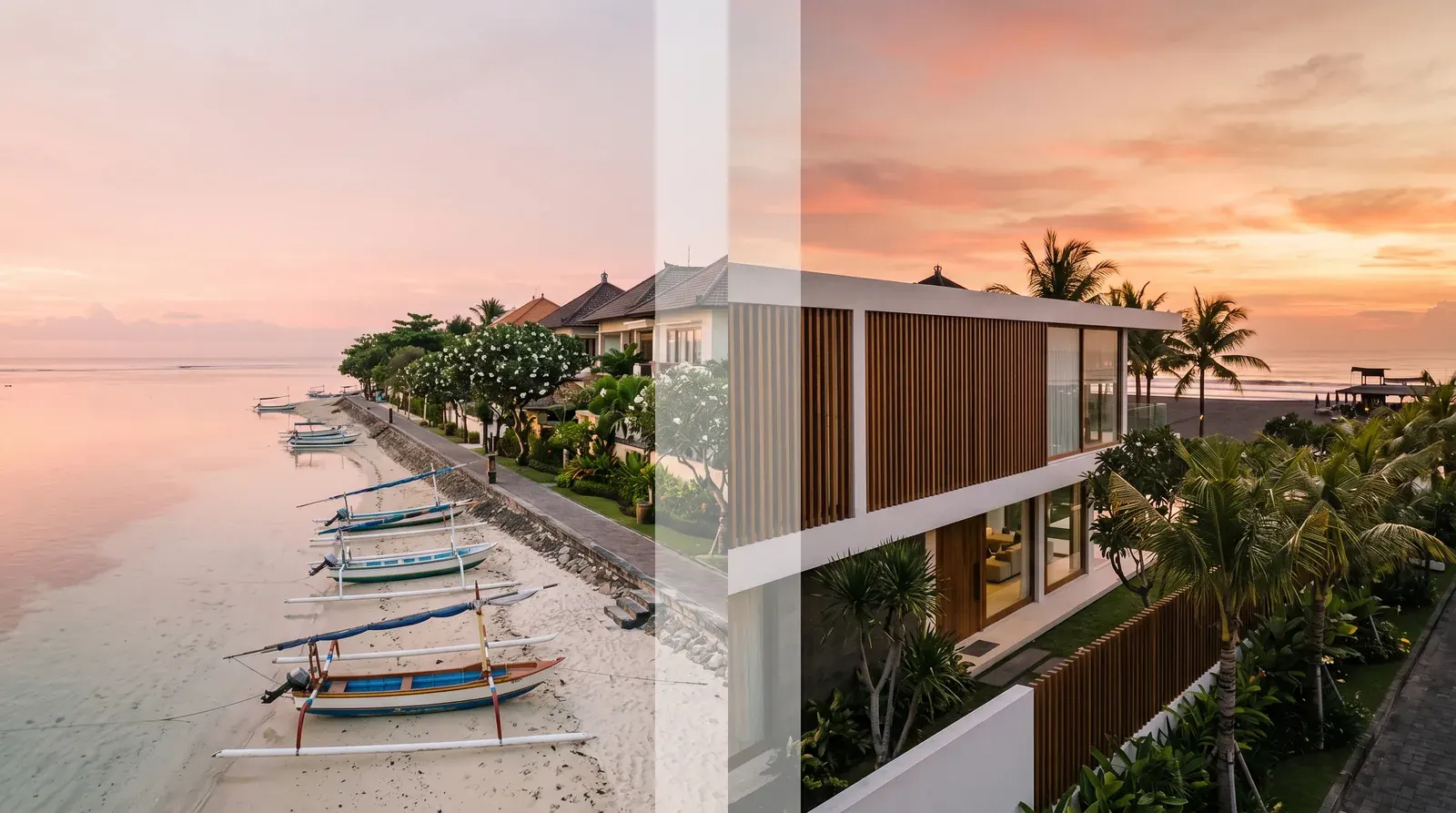
Sanur vs Seminyak for 2026 foreign investors – mature east-coast expat district versus urban beach-club corridor, yields, prices, long-stay versus short-stay rental economics.
Quick facts
- 01Sanur and Seminyak both sit in the established-corridor tier but solve different problems: Sanur is the residential expat market with long-stay rentals; Seminyak is the urban beach-club corridor with short-stay yield density.
- 02Sanur entry at $300–500k for investor-grade villas; Seminyak entry at $400–700k for comparable independent villa product.
- 03Sanur delivers 7–10% gross yields with material long-stay rental income; Seminyak delivers 8–12% gross primarily through short-stay turnover.
- 04Sanur has Bali's most established expat residential infrastructure (BIMC, international schools, walkable village); Seminyak has Bali's deepest urban lifestyle amenity stack (beach clubs, restaurants, brand retail).
Key Takeaways
- Sanur and Seminyak both sit in the established-corridor tier but solve different problems: Sanur is the residential expat market with long-stay rentals; Seminyak is the urban beach-club corridor with short-stay yield density.
- Sanur entry at $300–500k for investor-grade villas; Seminyak entry at $400–700k for comparable independent villa product.
- Sanur delivers 7–10% gross yields with material long-stay rental income; Seminyak delivers 8–12% gross primarily through short-stay turnover.
- Sanur has Bali's most established expat residential infrastructure (BIMC, international schools, walkable village); Seminyak has Bali's deepest urban lifestyle amenity stack (beach clubs, restaurants, brand retail).
- Choose Sanur for stability with year-round residential utility; choose Seminyak for yield density with urban beach-anchored short-stay tourism exposure.
The one-minute read
Sanur and Seminyak are Bali's two most established mature corridors, but they trade on different fundamentals. Sanur is the east-coast expat district with mature village infrastructure, long-stay rental depth, and the cleanest foreigner-buyer title history on Bali. Seminyak is the urban beach-club corridor with short-stay yield density, branded retail anchors, and the fastest resale liquidity.
If you are buying for lower entry price, balanced rental flexibility, or eventual residential use, Sanur wins. If you are buying for yield density, urban beach-club access, and faster turnover, Seminyak wins. Both are credible foreign-investor markets – the choice is about lifestyle utility and rental model.
Sanur sells residential community. Seminyak sells urban beach lifestyle. They are different products even though both rate as mature, lower-volatility Bali markets.
Why this comparison matters
Most "Sanur vs Seminyak" content frames the comparison as quiet-versus-busy. The real split is structural: Sanur is the only Bali corridor where foreigners can credibly underwrite a second-home-to-retirement progression with full residential infrastructure; Seminyak is the only Bali corridor where foreigners can credibly underwrite a beach-club-anchored urban short-stay portfolio.
The buyer who lands in Seminyak after researching Sanur typically discovers within twelve months that the rental flexibility they assumed (long-stay tenants, family rentals) does not exist at scale in Seminyak. The buyer who lands in Sanur after researching Seminyak typically discovers the nightly ADR ceiling is structurally lower. Mis-mapping the corridor to the actual goal is the most common framing error.
Sanur – the residential community case
Sanur's investment thesis rests on three structural facts.
Cleanest title history on Bali. Sanur has been a foreigner-buyer corridor since the 1990s. PPAT notary familiarity with foreign-buyer structures is the deepest on the island; leasehold extension precedent is the most established; title disputes are vanishingly rare. The legal-process safety here is structural, not promotional.
Year-round residential infrastructure. Bali Mandara Hospital (BIMC), Sanur International Hospital, Bali International School, Sanur Independent School, Bali Orthopedic Hospital, mature grocery, walkable beach promenade, restaurant scene built for long-stay residents rather than peak-season tourists. No other Bali corridor approaches this depth of expat residential infrastructure.
Balanced rental economics. Sanur villa stock supports both nightly short-stay (40–60% of typical rental days) and monthly long-stay (40–60%) with a substantial Australian, Russian, and European retiree-track segment that pays for three to twelve month rentals. This rental mix is unique on Bali – no other corridor sustains long-stay demand at this scale.
The structural weaknesses are nightly ADR ceiling and capital appreciation ceiling. Sanur nightly rates are below Seminyak / Canggu peaks because the corridor competes on long-stay price rather than peak nightly leisure pricing. Capital appreciation has been steady at 3–5% USD annual but lower than growth corridors.
Seminyak – the urban beach yield case
Seminyak's investment thesis rests on different structural facts.
Brand anchor density. Potato Head, Ku De Ta, La Plancha, W Bali, Alila Seminyak, Petitenget retail strip, Eat Street restaurants. No Bali corridor has comparable brand anchor density driving organic walkable demand. This sustains Seminyak's 20–35% nightly pricing premium over equivalent inland or non-anchored product.
Mature licensed inventory. Most Seminyak stock dates from 2010–2020 with established PBG / SLF documentation. Licensed-versus-unlicensed ratio is high. The 2025 zoning enforcement wave was largely a non-event for Seminyak.
Resale liquidity. Seminyak transactions trade with the tightest bid-ask spreads on Bali and the most global buyer pool. Days-on-market for fairly-priced units is 60–120 versus 90–180 for Sanur. If exit liquidity matters, Seminyak is structurally superior.
The structural weaknesses are pricing power compression (growth-corridor capital flowed north to Canggu and Pererenan), operational intensity (short-stay-dominant model requires professional management), and lower year-round residential utility (the corridor is built for visiting, not living).
Sub-zone benchmarks (2026)
Both corridors have meaningful sub-zone variance.
| Sub-zone | $/m² new-build | Gross yield range | Position |
|---|---|---|---|
| Sanur Beach core (Mertasari) | $3,500–4,800 | 7–10% | Walkable beach, expat dense |
| Sanur central / Tamblingan | $3,000–4,200 | 7–9% | Walking distance to beach |
| Sindhu / Sanur Beach | $3,200–4,500 | 7–10% | Beach + restaurant strip |
| Renon (Sanur border) | $2,800–3,800 | 8–11% | Inland, lower entry |
| Bypass corridor | $2,500–3,400 | 7–10% | Drive to beach, cheapest entry |
| Seminyak core (Eat Street) | $4,200–5,500 | 9–12% | Restaurant and retail anchor |
| Petitenget / Oberoi | $4,500–6,200 | 8–11% | Premium beach-club anchor |
| Seminyak Beach front | $5,000–7,000+ | 7–10% | Trophy positions |
| Kerobokan border | $3,200–4,300 | 9–12% | Cheaper Seminyak-side entry |
| Drupadi / inland Seminyak | $3,000–4,000 | 9–13% | Less walkable, higher yield |
The Sanur Beach core tier and the Kerobokan border / inland Seminyak tier are where most $400–600k cross-corridor decisions get made.
How the two corridors respond to macro shocks
The cycle behaviour distinguishes them.
2020 tourism shock. Both corridors held within 5–10% of pre-shock pricing. Sanur outperformed on rental utilisation because the expat residential base sustained partial occupancy through long-stay tenants who did not leave. Seminyak nightly occupancy collapsed but pricing held because of low transactional volume.
2022 reopening. Seminyak rebuilt nightly pricing and occupancy ahead of Sanur. Sanur rebuilt long-stay rentals steadily through 2022 with less peak-season dependence. Seminyak yield recovered faster; Sanur stability held throughout.
2025 enforcement. Both corridors largely unaffected. Sanur's licensed-inventory ratio is high because the foreigner-buyer market has been compliant for two decades. Seminyak's mature stock is similarly clean.
The pattern: Sanur compresses less in shocks but recovers more slowly; Seminyak compresses more but recovers faster. Pick the volatility profile that matches your hold horizon and rental model.
Common decision errors
- Buying Seminyak with Sanur long-stay rental expectations. Long-stay tenants at scale do not exist in Seminyak. The corridor is built for short-stay tourism. If you need balanced rental flexibility, buy Sanur.
- Buying Sanur with Seminyak nightly ADR expectations. Sanur nightly rates are structurally below Seminyak. Underwriting Sanur on Seminyak comparables overstates the rental forecast by 20–30%.
- Underestimating Sanur's foreigner-buyer market depth. Sanur transactional volume is lower than Seminyak but the buyer pool is structurally stable. Resale takes longer but at closer-to-asking prices.
- Treating Sanur Beach core and Renon as the same sub-market. Beach core trades on walkable beach access; Renon is inland with different demographics. Different underwriting.
- Pricing 2019 comparables. Both corridors have moved 15–25% in $/m² terms since 2019. Comparables older than 18 months are unreliable.
Which fits which investor
Sanur fits if you:
- Want lower entry price for investor-grade product
- Plan eventual or partial residential use (second-home or retirement)
- Value mature expat infrastructure and healthcare access
- Accept 7–10% gross yields with balanced rental model
- Have a 7–15 year hold horizon, possibly transitioning to residence
Seminyak fits if you:
- Want yield density on short-stay rental
- Are willing to engage professional STR management
- Value walkable urban beach-club lifestyle
- Accept 20–35% pricing premium for brand anchors
- Have a 5–10 year hold horizon, primarily as investment
Methodology and sources
Yield and pricing data triangulated from Bali Villa Select editorial desk tracked figures, Knight Frank Indonesia, Statistics Indonesia BPS visitor data, Sanur expat community-tracked rental disclosures, and Horwath HTL Bali 2026 report. Sub-zone $/m² ranges reflect editorial-desk tracked transactions for Q1–Q2 2026.
Single-source agency or off-market figures are excluded because public benchmarking found them consistently 20–50% off the public median in this niche.
Last validated: June 2026.
Related analysis
| Dimension | Sanur | Seminyak | Edge |
|---|---|---|---|
| Typical gross yield (managed) | 7–10% | 8–12% | Seminyak |
| Investor-grade entry | $300k–$500k villa | $400k–$700k villa | Sanur |
| Prime tier | $500k–$900k beachfront villa | $700k–$1.5M+ Petitenget / beachfront | Sanur |
| Rental model | Balanced nightly + monthly long-stay | Predominantly nightly short-stay | Tie |
| Dominant guest profile | Families, retirees, long-stay expats | Couples, lifestyle leisure, beach-club | Tie |
| Beach character | Calm, snorkel-friendly, sunrise | Calm, walkable beach-club, sunset | Tie |
| Year-round residential utility | High (mature village, walkable) | Lower (urban, more transient) | Sanur |
| Healthcare infrastructure | BIMC + Sanur International on-corridor | BIMC Kuta 10–15 min drive | Sanur |
| Beach-club anchor density | Low (a few resort beach clubs) | Highest in Bali | Seminyak |
| Resale liquidity | Steady, longer days-on-market | High, faster turnover | Seminyak |
| Volatility (historical) | Low | Medium | Sanur |
Frequently Asked
Which is better for foreign property investment, Sanur or Seminyak?
Different profiles fit each. Sanur fits buyers prioritising lower entry price, year-round residential utility, and long-stay rental flexibility. Seminyak fits buyers prioritising yield density, walkable urban beach lifestyle, and short-stay tourism exposure. Sanur is structurally cheaper and more residential; Seminyak is structurally more lifestyle-yield-driven.
Which has higher rental yield?
Seminyak, by 1–2 percentage points on short-stay turnover. Investor-grade Seminyak villas deliver 8–12% gross yields; Sanur runs 7–10% gross. The gap is rental model: Seminyak monetises peak nightly leisure pricing; Sanur monetises a balanced mix of nightly and monthly long-stay rentals. Net yields converge after operational variance is accounted for.
Is Sanur underpriced compared to Seminyak?
Per square meter, Sanur trades at roughly 20–35% below Seminyak for comparable new-build stock. Whether that is underpriced or correctly priced depends on weighting – the discount reflects Sanur's slower capital appreciation, lower nightly ADR, and absence of beach-club anchor density. The pricing relationship is structural, not a temporary inefficiency.
Which area is better for long-term residential use?
Sanur, decisively. Sanur has the densest expat infrastructure in Bali – BIMC and Sanur International Hospital, multiple international schools, walkable village structure, mature expat community. Seminyak is more urban and less family-oriented; many Seminyak villa owners use the property part-time. Sanur fits the second-home-to-retirement progression that Seminyak typically does not.
Can foreigners buy property in Sanur as easily as Seminyak?
Yes – Sanur is actually the most foreigner-buyer-friendly Bali corridor by track record. Foreigners have been buying Sanur leasehold property since the 1990s, which means clearer title history, more PPAT notary familiarity, and stronger leasehold extension precedent than any other Bali corridor. Both areas accept leasehold and PT PMA structures.
Which had better capital appreciation in the last 5 years?
Seminyak slightly outperformed Sanur in $/m² appreciation 2019–2024, but both lagged Canggu and Uluwatu growth corridors. The pattern: Sanur appreciates steadily at 3–5% USD annual; Seminyak appreciates at 4–6% USD annual with higher year-to-year variance. Neither is a high-growth corridor in the 2026 framework.
Sources
- Bali Tourism Board – visitor statisticsaccessed June 9, 2026
- Statistics Indonesia (BPS) – Bali tourism arrivalsaccessed June 9, 2026
- Knight Frank Indonesia – Bali residential reviewaccessed June 9, 2026
- Sanur Village Festival – cultural and demand dataaccessed June 9, 2026
- Horwath HTL – Bali hotel and branded residences 2026accessed June 9, 2026