Inside Bali
Nusa Dua vs Seminyak Property Investment: Which Bali Market in 2026?
Nusa Dua vs Seminyak for 2026 investors – master-planned luxury versus urban beach club, yield benchmarks, entry prices, exit liquidity, and the buyer profiles each corridor actually fits.
Quick facts
- 01Nusa Dua delivers 6–9% gross yields with the lowest volatility on Bali; Seminyak delivers 8–12% gross with higher turnover and stronger walkability.
- 02Nusa Dua entry sits at $400–800k for branded residential product; Seminyak entry at $400–700k for investor-grade villas, with prime tiers in both corridors crossing $1.5M.
- 03Nusa Dua is a master-planned ITDC zone with the strictest zoning and lowest regulatory risk in Bali; Seminyak is open-market urban with established licensed inventory.
- 04Different demand engines: Nusa Dua runs on hotels, conferences, and luxury family leisure; Seminyak runs on beach club anchors, dining, and walkable lifestyle tourism.
Key Takeaways
- Nusa Dua delivers 6–9% gross yields with the lowest volatility on Bali; Seminyak delivers 8–12% gross with higher turnover and stronger walkability.
- Nusa Dua entry sits at $400–800k for branded residential product; Seminyak entry at $400–700k for investor-grade villas, with prime tiers in both corridors crossing $1.5M.
- Nusa Dua is a master-planned ITDC zone with the strictest zoning and lowest regulatory risk in Bali; Seminyak is open-market urban with established licensed inventory.
- Different demand engines: Nusa Dua runs on hotels, conferences, and luxury family leisure; Seminyak runs on beach club anchors, dining, and walkable lifestyle tourism.
- Choose Nusa Dua for capital preservation with hotel-grade infrastructure; choose Seminyak for yield density with urban beach access.
The one-minute read
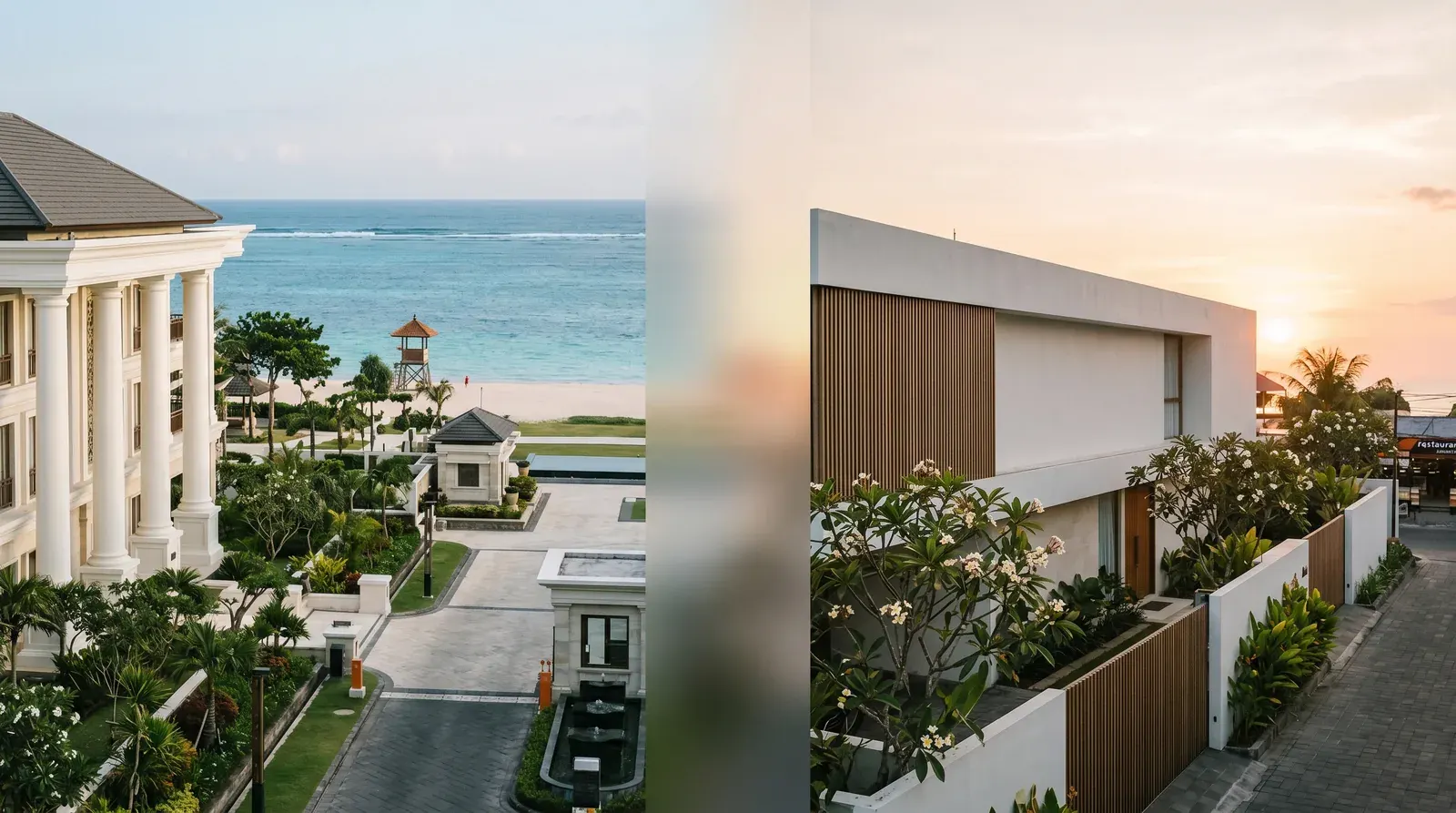
Nusa Dua and Seminyak are Bali's two most established corridors, and the comparison is almost always misframed as a luxury-versus-fun binary. The actual split is structural: Nusa Dua is a master-planned ITDC zone with hotel-grade infrastructure and the lowest volatility on the island; Seminyak is an open-market urban beach corridor with higher yield density and walkable lifestyle.
If you are buying for capital preservation with infrastructure-grade fundamentals, Nusa Dua wins. If you are buying for yield with urban beach access, Seminyak wins. Both are credible foreign-investor markets – the choice is what you optimise for.
Nusa Dua sells institutional stability. Seminyak sells lifestyle yield. They are different products with different demand engines, not interchangeable beach corridors.
Why this comparison matters
A foreign investor weighing Nusa Dua against Seminyak is usually weighing two different things even if they do not realise it. Nusa Dua is the closest Bali gets to institutional real estate – ITDC master-planned, controlled supply, hotel-anchored demand, family-grade infrastructure. Seminyak is the closest Bali gets to mature urban beach product – open market, walkable beach clubs, restaurants, brand retail, organic supply.
The buyer who lands in Nusa Dua after researching Seminyak is usually buying the wrong product for the actual goal, and the same is true in reverse. Before comparing price or yield, decide whether you want institutional discipline or urban lifestyle yield. The rest of the comparison falls out of that.
Nusa Dua – the institutional case
Nusa Dua's investment thesis rests on three structural facts.
Master-planned zoning. The Nusa Dua / ITDC area was developed under a single master plan with strict use restrictions, hotel-anchored land use, and centralised infrastructure (water, sewage, road, security). The 2025 zoning enforcement wave that affected Canggu and Pererenan passed Nusa Dua with negligible impact because the licensed-versus-unlicensed ratio is structurally near 100%.
Branded residence depth. Mulia Residences, Apurva Kempinski branded units, St. Regis residences, Bvlgari Resort residences, Aman Villas at Nusa Dua – the branded residence inventory in Nusa Dua is the deepest in Bali, with established operator agreements and revenue-share structures. This creates pricing discipline and exit-side liquidity that organic villa product cannot match.
Demand quality. Nusa Dua runs on luxury families, branded-hotel guests, and Bali's MICE (meetings, incentives, conferences) base. Average stay length is 5–8 nights versus 3–4 in beach-club corridors. Occupancy is structurally lower (55–70%) but ADR is structurally higher and demand is less weather-sensitive.
The structural weaknesses are yield ceiling and operational dependence on the branded operator. Yields stay in the 6–9% gross range because nightly turnover is structurally lower. Branded residences are often locked into hotel-pool revenue share, capping independent rental upside. The 'lowest volatility on Bali' designation is real, and so is the lower yield ceiling that comes with it.
Seminyak – the urban yield case
Seminyak's investment thesis rests on different structural facts.
Mature licensed inventory. Most Seminyak villa and apartment stock dates from 2010–2020 with established PBG / SLF documentation and clearer title history. The corridor's licensed-versus-unlicensed ratio is the second-highest in Bali after Nusa Dua. The 2025 enforcement wave was largely a non-event for Seminyak.
Brand anchor density. Potato Head, Ku De Ta, La Plancha, W Bali, Alila Seminyak, Petitenget retail strip, Eat Street restaurants. No other Bali corridor has comparable brand anchor density driving organic walkable demand. This is what sustains Seminyak's 20–30% nightly pricing premium over equivalent inland product.
Yield density per dollar. Independent Seminyak villas deliver 8–12% gross yields with operational flexibility that branded Nusa Dua product does not allow. You control your channels, your pricing, your guest profile, your renovation cycle. That control is worth a yield premium over the hotel-pool model.
The structural weaknesses are pricing power compression (Seminyak prices have moved less than Canggu since 2022 because growth-corridor capital flowed north) and operational intensity (independent management requires real capacity).
Sub-zone benchmarks (2026)
Both corridors are not monolithic. The yield and pricing variance within each is meaningful.
| Sub-zone | $/m² new-build | Gross yield range | Position |
|---|---|---|---|
| Nusa Dua ITDC core | $4,500–6,500 | 6–8% (branded pool) | Branded residences, hotel-pool |
| Nusa Dua independent villa | $3,800–5,200 | 7–9% | Independent rental, ITDC border |
| Sawangan / Geger Beach | $3,500–4,800 | 7–10% | Quieter beach, family-grade |
| Tanjung Benoa | $3,200–4,400 | 8–11% | Water-sport adjacent, mid-tier |
| Seminyak core (Eat Street) | $4,200–5,500 | 9–12% | Restaurant and retail anchor |
| Petitenget / Oberoi | $4,500–6,200 | 8–11% | Premium beach club anchor |
| Seminyak Beach front | $5,000–7,000+ | 7–10% | Trophy positions |
| Kerobokan border | $3,200–4,300 | 9–12% | Cheaper entry on Seminyak side |
| Drupadi / inland Seminyak | $3,000–4,000 | 9–13% | Less walkable, higher yield |
The Nusa Dua independent villa / Sawangan tier and the Kerobokan border / inland Seminyak tier are where most $400–600k cross-corridor decisions actually happen.
How the two corridors respond to macro shocks
The cycle behaviour is informative.
2020 tourism shock. Both corridors went to near-zero occupancy. Nusa Dua values held within 3–7% of pre-shock pricing (hotel-pool structures absorbed the volatility on the operator side); Seminyak held within 5–10%. Recovery curve was faster in Seminyak (back to 60% occupancy by Q1 2023) because urban dining and beach-club traffic returned ahead of MICE.
2022 reopening. Seminyak rebuilt nightly pricing and occupancy ahead of Nusa Dua. Nusa Dua MICE traffic took until late 2023 to fully recover. Yield convergence narrowed during this phase.
2025 enforcement. Nusa Dua: no direct impact. Seminyak: minimal impact, isolated to a small number of non-compliant smaller properties. Compared to Canggu's direct hit, both corridors looked structurally sound.
The pattern: Nusa Dua compresses less and recovers more slowly. Seminyak compresses more and recovers faster. Pick the volatility profile that matches your hold horizon.
Common decision errors
- Buying Nusa Dua branded residence expecting independent yield. Branded residences are typically locked into hotel-pool revenue share, which caps independent upside. The yield is more predictable but lower. If you want independent control, buy independent villa product (Nusa Dua periphery or Seminyak).
- Buying Seminyak prestige with Canggu yield expectations. Seminyak is a mature corridor with 8–12% gross yields, not 13–15%. Comparing it to Canggu's headline yields creates miscalibration. Compare it to Nusa Dua – that is the apples-to-apples comparison.
- Underestimating operational variance in independent Seminyak product. The 10% gross yield assumes professional STR management. Without it, the realised yield is 30–40% lower.
- Treating Nusa Dua and Sawangan as the same submarket. They are not. ITDC core trades on branded operator economics; Sawangan trades on independent villa economics. Different underwriting.
- Pricing 2019 comparables. Both corridors have moved meaningfully since 2019. Comparables older than 18 months are unreliable for current underwriting.
Which fits which investor
Nusa Dua fits if you:
- Want the lowest-volatility Bali market
- Are comfortable with branded operator economics if buying branded
- Value gated-resort infrastructure and security
- Accept 6–9% gross yields for asset stability
- Have a 7–12 year hold horizon
Seminyak fits if you:
- Want yield density with operational flexibility
- Are willing to engage active management
- Value walkable urban beach lifestyle
- Accept moderate volatility for 8–12% gross
- Have a 5–10 year hold horizon
Methodology and sources
Yield and pricing data triangulated from Bali Villa Select editorial desk tracked figures, ITDC Nusa Dua master plan documentation, Knight Frank Indonesia, Horwath HTL Bali branded residences 2026, and Bali Tourism Board visitor statistics. Branded residence yields reflect disclosed operator P&L; independent villa yields reflect editorial-desk tracked transactions for Q1–Q2 2026.
Single-source agency or off-market figures are excluded because public benchmarking found them consistently 20–50% off the public median in this niche.
Last validated: June 2026.
Related analysis
| Dimension | Nusa Dua | Seminyak | Edge |
|---|---|---|---|
| Typical gross yield (managed) | 6–9% | 8–12% | Seminyak |
| Investor-grade entry | $400k–$800k branded | $400k–$700k villa | Tie |
| Prime tier | $800k–$1.5M+ branded residences | $700k–$1.5M+ beachfront / Petitenget | Tie |
| Zoning and legal risk | Lowest in Bali (ITDC master-plan) | Low (mature licensed inventory) | Nusa Dua |
| Dominant guest profile | Luxury families, conferences (MICE) | Couples, lifestyle leisure, beach-club | Tie |
| Nightly ADR range | $280–$700 (branded residences) | $250–$600 | Nusa Dua |
| Occupancy (managed) | 55–70% | 55–70% | Tie |
| Beach quality | Calm, swim-friendly, lifeguarded | Calm, walkable beach-club anchored | Tie |
| Walkability to amenities | Low (resort-grouped, gated) | High (urban grid, walkable beach) | Seminyak |
| Resale liquidity | Tight pricing, thinner volume | Wider buyer pool, faster turnover | Seminyak |
| Volatility (historical) | Lowest in Bali | Medium | Nusa Dua |
Frequently Asked
Is Nusa Dua or Seminyak better for property investment?
Different profiles fit each. Nusa Dua suits buyers prioritising the lowest-volatility Bali market – master-planned ITDC zoning, hotel-grade infrastructure, luxury family demand. Seminyak suits buyers prioritising yield with urban walkable beach lifestyle, beach-club anchored demand, and tighter resale spreads. Neither is universally better.
Which has higher rental yield?
Seminyak, by 2–4 percentage points. Investor-grade Seminyak villas deliver 8–12% gross yields; Nusa Dua villa product runs 6–9% gross. The gap reflects demand structure – Seminyak runs on shorter-stay leisure traffic with high turnover, while Nusa Dua runs on longer-stay luxury and conference traffic that yields lower nightly density.
Why is Nusa Dua considered safer than Seminyak?
Nusa Dua was developed by Indonesia Tourism Development Corporation (ITDC) as a master-planned resort zone with stricter zoning enforcement, better infrastructure, and tighter title history. The 2025 zoning enforcement wave passed Nusa Dua almost completely. Seminyak is open-market urban with more diverse stock quality, though its licensed-inventory ratio is high after a decade of regularisation.
Can I get freehold-equivalent ownership in either area?
Neither offers freehold to foreigners – Indonesia does not. Both areas use leasehold (Hak Sewa, 25–30 years) or PT PMA structures with HGB (up to 80 years effective). Nusa Dua has a higher share of branded residential product with structured leasehold packages; Seminyak has more independent villa product with bespoke leasehold or PMA setups. Same structural options, different market depth in each.
Which is better for owner-occupier use plus rental?
Nusa Dua if you value gated-resort infrastructure, family-grade safety, and longer personal-use stays with hotel-pool revenue-share options. Seminyak if you value walkable beach-club and restaurant access for personal lifestyle. Owner-occupier yield in Nusa Dua tends to disappoint because the hotel-pool model limits independent rental upside; Seminyak independent villa rental yields stay closer to the headline.
What is the typical exit liquidity in each?
Both corridors trade with tighter spreads than the Bali average. Seminyak has stronger global buyer pool depth and faster days-on-market; Nusa Dua has thinner volume but tighter price discipline because supply is constrained by ITDC zoning. Resale timeline: Seminyak 60–120 days for fairly-priced units, Nusa Dua 90–180 days but at closer-to-asking prices.
Sources
- Indonesia Tourism Development Corporation (ITDC) – Nusa Dua master planaccessed June 9, 2026
- Bali Tourism Board – visitor statisticsaccessed June 9, 2026
- Knight Frank Indonesia – Bali residential reviewaccessed June 9, 2026
- Horwath HTL – Bali hotel and branded residences 2026accessed June 9, 2026
- Statistics Indonesia (BPS) – Bali tourism arrivalsaccessed June 9, 2026