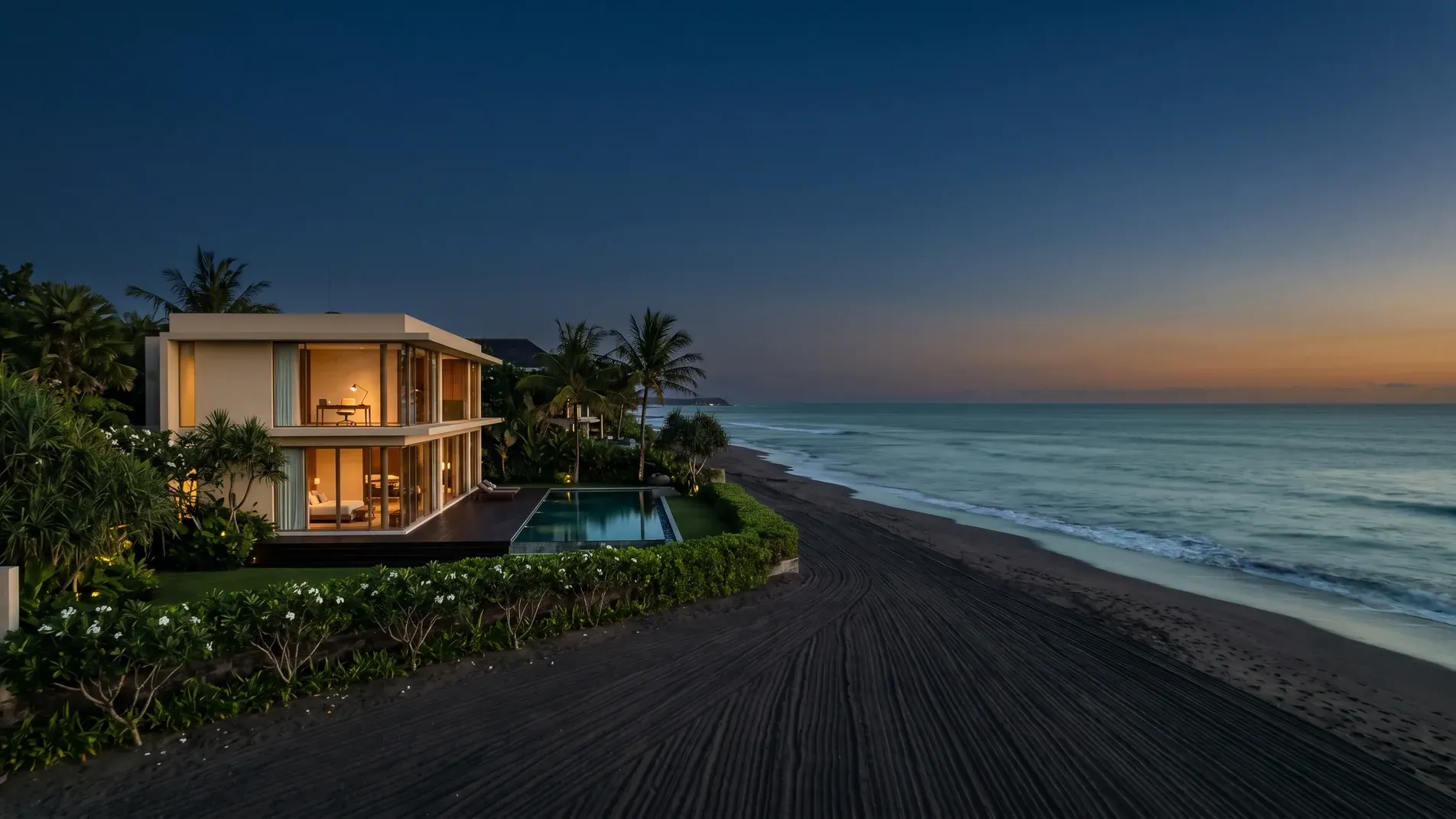
Badung · Mature beach corridor
Seminyak, the mature stability tier.
Bali's most-mature foreign-buyer corridor, defended by deep mature infrastructure, resale-market depth, and the lowest yield-variance reading on the island. Lower ceiling than Canggu and Bukit, but the steadiest cash-flow profile and the fastest 90–120 day resale velocity on Bali.
Informational material · Not a sales call · Editorial reply, not a broker pitch
Entry band
$400k–$1.2M
single villa, 240–420 m² built
Price / m²
$3,500–$5,200
built area, established corridor
Gross yield
8–12%
before fees, occupancy 70–80%
Net yield (est.)
5–9%
after manager + utilities + tax
ADR range
$260–$580
mature segment, deep velocity
Risk profile
Low-Mid · infrastructure-rich, mature-cycle
Source-tier breakdown: BPS · BKPM · platform statements · editorial diligence. Methodology → · Cited by →
Informational material · Not a sales call · Editorial reply, not a broker pitch
The qualifier
Whether Seminyak is your corridor.
For investors who
Seminyak rewards
- hold 5–10 years and underwrite to steady cashflow rather than peak yield
- prioritize resale liquidity — Seminyak has Bali's deepest comp data and fastest 90–120 day turnaround
- want exposure to the established expat-and-tourist demographic that anchors the corridor
- value mature legal precedent, settled licensing, and deep professional-services density
Not for investors who
Seminyak punishes
- are targeting peak STR yield — Canggu delivers higher absolute yield range
- want emerging-market capital-appreciation upside — most Seminyak runway is already in
- are buying for clifftop premium-tier — go Uluwatu
- expect rapid corridor change — Seminyak's pace is its asset, not its limitation
The micro-map
Sub-corridors of Seminyak.
The corridor name hides sub-markets that diverge on price, supply quality, and risk character.
Beachfront-adjacent
Petitenget premium
The premium tier of Seminyak. Beachfront-adjacent inventory, walking to Potato Head and W Bali, anchored by Bulgari precinct. Pricing power defends through cycles.
Mature mid-tier
Central Seminyak core
The mature volume tier around Eat Street, Kayu Aya, Drupadi. Walking access to F&B concentration, settled neighborhood character, deepest rental velocity.
Value-tier
Kerobokan / Berawa border
Entry tier of Seminyak (and upper tier of Canggu, depending on which side of the border the parcel sits). Better yield ceiling, less liquidity, capital-appreciation runway.
Hold tier
Beachfront-adjacent ultra-luxury
North of W Seminyak — scarce inventory, premium positioning, hold-for-appreciation profile. Lower yield, defended pricing through cycles.
Recent comparables
What actually transacted.
Anonymised signed comps the desk read this quarter. The structure is the point: tenure, size, and the note the brochure omits.
| Quarter | Sub-corridor | Size built / land | Tenure | Price | $/m² | Editorial note |
|---|---|---|---|---|---|---|
| Q2 2026 | Petitenget premium | 320 / 520 m² | Hak Milik via PMA–HGB | $1.45M | $4,531 | Beachfront-adjacent; verified 12-month reconciliation |
| Q2 2026 | Central Seminyak core | 280 / 380 m² | Leasehold 27 yr · extension clause | $745k | $2,661 | Eat Street walk-to F&B; mature manager handover |
| Q1 2026 | Kerobokan / Berawa border | 260 / 420 m² | Leasehold 28 yr | $525k | $2,019 | Berawa-adjacent; 11% gross steady-state |
| Q1 2026 | Petitenget premium | 380 / 680 m² | Hak Milik via PMA–HGB | $2.15M | $5,658 | Bulgari precinct adjacency; predictable rate |
| Q4 2025 | Central Seminyak core | 240 / 320 m² | Leasehold 25 yr | $685k | $2,854 | Kayu Aya walkable; resold after one cycle |
| Q4 2025 | Beachfront-adjacent ultra-luxury | 420 / 760 m² | Hak Milik via PMA–HGB | $2.85M | $3,750 | Brand-residence association; defended pricing |
- Size
- 320 / 520 m²
- Tenure
- Hak Milik via PMA–HGB
- $/m²
- $4,531
Beachfront-adjacent; verified 12-month reconciliation
- Size
- 280 / 380 m²
- Tenure
- Leasehold 27 yr · extension clause
- $/m²
- $2,661
Eat Street walk-to F&B; mature manager handover
- Size
- 260 / 420 m²
- Tenure
- Leasehold 28 yr
- $/m²
- $2,019
Berawa-adjacent; 11% gross steady-state
- Size
- 380 / 680 m²
- Tenure
- Hak Milik via PMA–HGB
- $/m²
- $5,658
Bulgari precinct adjacency; predictable rate
- Size
- 240 / 320 m²
- Tenure
- Leasehold 25 yr
- $/m²
- $2,854
Kayu Aya walkable; resold after one cycle
- Size
- 420 / 760 m²
- Tenure
- Hak Milik via PMA–HGB
- $/m²
- $3,750
Brand-residence association; defended pricing
6 of 12 transactions the desk read this quarter on the Seminyak tier. Cross-corridor pricing reads against Canggu and the broader stability frame.
The licensing read
Regulatory landscape
Seminyak sits inside Badung regency on the southwest coast — the historical core of Bali's foreign-buyer market. The Badung RTRW zoning is generally cleaner here than in the newer Canggu inland corridors. Most Seminyak inventory has clear Pariwisata or mixed-use commercial classification, and the corridor's older development means most properties have established licensing precedent. The desk still verifies zoning on every Seminyak listing, but surprises are rarer than in the Canggu inland and Bukit hillside corridors.
Licensing through Pondok Wisata runs the Badung regency path. PBG backlog here is comparable to Canggu — typical time-to-permit is 5–8 months — but the broker, notary, and licensing-professional pool is deeper. The corridor has the most experienced foreign-buyer professional infrastructure on Bali, which materially de-risks the licensing path.
Tenure mix in Seminyak is balanced — roughly 60% leasehold, 35% Hak Milik through PMA–HGB structures, 5% direct freehold. The mature resale market actively prices remaining lease term — a villa with 28 years remaining trades at 25–30% premium over comparable inventory with 18 years remaining. Lease-term diligence is more material here than in newer corridors.
Recent direction: the 2025 enforcement wave was lighter on Seminyak than on the Canggu inland corridor, with established licensing precedent and clean zoning insulating most inventory. The structural offset is yield ceiling — mature corridors have less rental volatility but also less rental upside. See the safest-area framework for how the desk weights Seminyak on the risk-adjusted scale.
Boots on the ground
Operational reality
Property management mandates in Seminyak run 18–24% of revenue — tighter than the Canggu range because the operator pool is mature and the OTA-channel mix is settled. Premium Petitenget mandates with branded-management structures often run higher (22–28%) but deliver the resale-positioning premium that flat mandate cannot.
Seasonality is moderate. Peak runs June–August and December–January with 85%+ occupancy; the shoulder months hold at 60–70% on professionally managed product. Underwrite to 70% blended occupancy for stability-tier inventory and the numbers hold predictably; this is the corridor with the lowest yield-variance reading on Bali.
Channel mix is the most settled on Bali — Airbnb and Booking.com share the rotation, with direct-booking share at 30–40% by year two on well-positioned product. The mature operator pool means platform commission optimization is more sophisticated than in newer corridors.
Infrastructure on Seminyak is the deepest of any Bali corridor — mains water is reliable, power is stable, international-standard medical clinics, fibre internet throughout, established F&B and retail along Eat Street and Kayu Aya, and Ngurah Rai airport is 25–35 minutes via the bypass. The professional-services density (lawyers, notaries, agents) is the highest on Bali.
The truth the brochure leaves out
3 risks we underwrite around.
Yield ceiling vs Canggu
Seminyak cannot deliver Canggu's headline yield range. If your underwriting model needs 12%+ to clear, Seminyak is the wrong corridor. The ADR ceiling is structurally lower because the demographic that anchors stability pays for predictability, not peak rate.
Why we still publish on Seminyak: the volatility-adjusted return is the most competitive on Bali — the corridor that underwrites at 70% blended steady with 90–120 day resale beats one that hopes for 85% peak with longer resale tail.
Lease-term value decay in mature resale
Seminyak's mature resale market actively prices remaining lease term more aggressively than newer corridors. A villa with 18 years remaining is a fundamentally different financial product from one with 28 years — the discount can reach 25–30%.
Why we still publish on Seminyak: the diligence path is straightforward and the desk reads remaining term, extension clauses, and renewal track record on every Seminyak listing before pricing.
Limited capital-appreciation runway
Most Seminyak upside is mature. Investors hunting for capital growth typically rotate to Pererenan, Pecatu, or Sesehe instead. Seminyak is a corridor for cash-flow and resale liquidity, not for emerging-market appreciation.
Why we still publish on Seminyak: the Petitenget premium tier defends pricing through cycles, and beachfront-adjacent inventory has structural scarcity that holds capital value.
Editorial offer · SEMINYAK
Send a specific Seminyak listing. The desk will read it.
We read the certificate before the brochure, reconcile twelve months of platform data, and return a written editorial note within forty-eight hours. No follow-up sequence. No mailing list. No broker handoff unless you ask for one.
Editorial review. No charge. Not a sales call. We disclose any referral relationship on the article body, never inside the dossier.
Read it against its neighbours
Where Seminyak sits in the field.
Questions the desk gets
Seminyak, asked directly.
How much does a Seminyak villa cost in 2026?
Seminyak villas in 2026 range $400,000 (entry-tier 2-bedroom Kerobokan border) to $4M+ (premium beachfront-adjacent Petitenget). Investor-grade 2–3 bedroom villas with private pool: $600,000–$1.2M. Premium 3–4 bedroom Petitenget villas: $1.2M–$2.5M. Beachfront-adjacent and ultra-luxury: $2.5M–$4M+.
Is Seminyak a good area for property investment?
Yes for investors prioritising stability and mature infrastructure over emerging-market upside. Seminyak delivers Bali's most predictable yields (8–12% gross with low variance) and the deepest established expat-and-tourist infrastructure. The trade-off versus Canggu (10–15% gross) and Uluwatu (9–14% gross) is yield ceiling, not stability or downside.
Which Seminyak sub-zone is best for investment?
Petitenget for premium positioning and beachfront-adjacent inventory. Central Seminyak (around Eat Street and Kayu Aya) for mature-yield product with established rental velocity. Kerobokan and Berawa border for entry-tier value-per-m² with lower yield but better appreciation runway as the corridor extends. Choose based on whether you prioritise pricing power (Petitenget), liquidity (central), or value (Kerobokan).
Can foreigners buy a villa in Seminyak?
Foreigners cannot own Bali land freehold. Standard structures: leasehold (Hak Sewa, 25–30 years extendable) or PT PMA company ownership with HGB land rights (up to 80 years effective). Most Seminyak transactions use leasehold for single-villa owner-occupier intent and PT PMA for portfolio holdings or commercially-licensed STR operations.
What yield can I expect on a Seminyak villa?
Professionally managed Seminyak villas with 60%+ occupancy: 8–12% gross. Net after management fees, OTA cuts, maintenance, Pondok Wisata licensing fee (where applicable), and Indonesian withholding tax: typically 60–70% of gross, so 5–9% net for actively-managed villas. Petitenget premium villas trade lower yield (6–9%) for higher capital stability.
Seminyak vs Canggu – which is better?
Canggu has higher absolute yield (10–15% vs Seminyak's 8–12%) and better digital-nomad rental velocity, but with newer infrastructure and higher zoning risk. Seminyak has lower yield ceiling but mature stability, established expat and tourist infrastructure, deeper resale market. Canggu suits yield-maximizing investors; Seminyak suits stability-prioritizing investors.
The editorial trail
Related reading
This area read is updated quarterly. Last review: 13 June 2026. Next scheduled review: 13 September 2026. Material new licensing rulings or transaction-data shifts trigger interim updates. How we update articles →