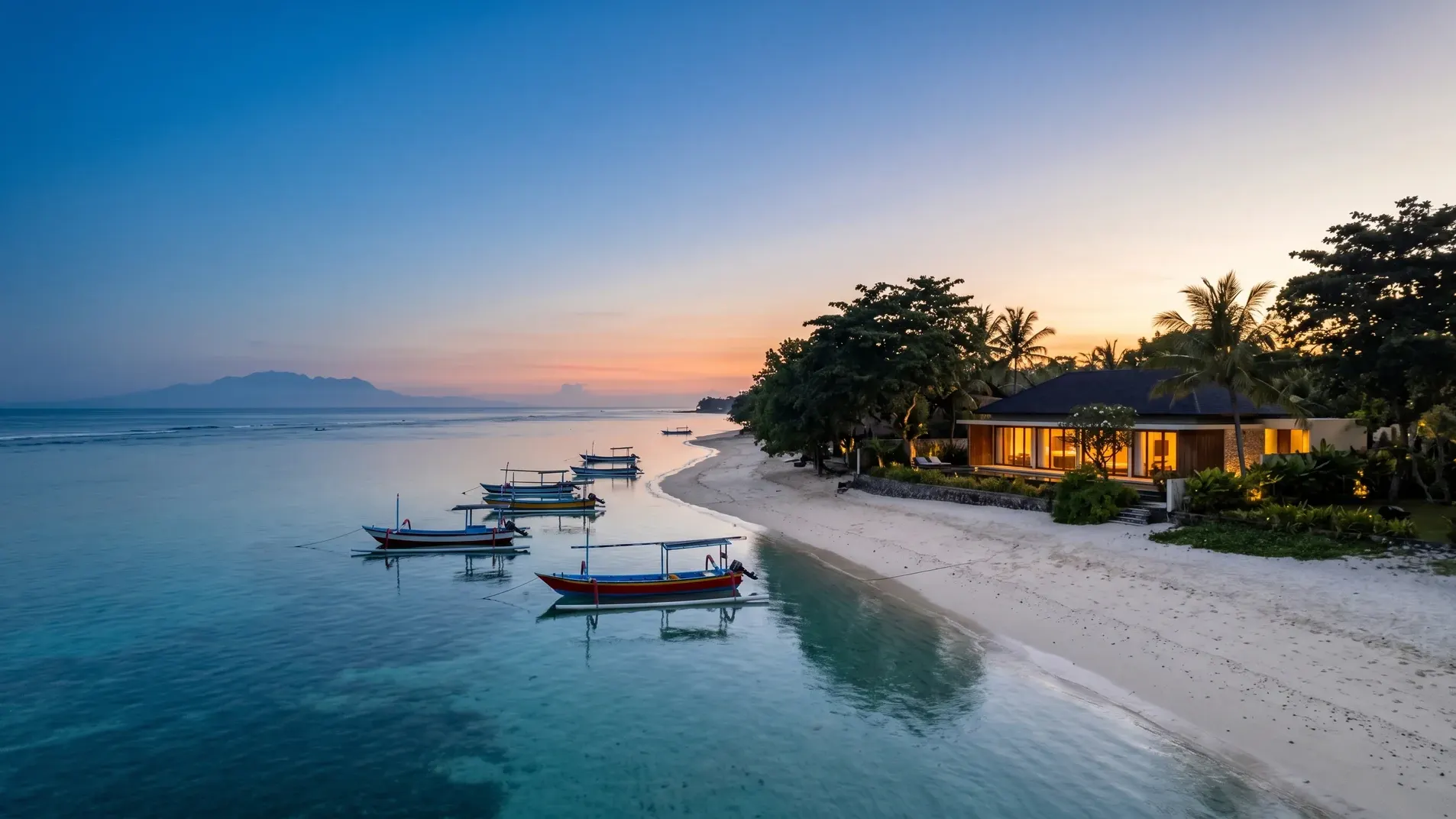
Denpasar · East coast
Sanur, the steady-hold corridor.
Calm reef-protected water, mature shade infrastructure, and a long-stay demographic that underwrites occupancy where headline ADR will not. Lower ceiling, steadier floor — Sanur is what the desk reads when the buyer needs the answer that does not require a marketing thesis.
Informational material · Not a sales call · Editorial reply, not a broker pitch
Entry band
$250k–$550k
single villa, 200–340 m² built
Price / m²
$1,300–$2,500
built area, established corridor reality
Gross yield
7–10%
before fees, occupancy 70–82%
Net yield (est.)
4–7%
after manager + utilities + tax
ADR range
$160–$280
mature segment, narrow peak premium
Risk profile
Low · infrastructure-rich, demographic-anchored
Source-tier breakdown: BPS · BKPM · platform statements · editorial diligence. Methodology → · Cited by →
Informational material · Not a sales call · Editorial reply, not a broker pitch
The qualifier
Whether Sanur is your corridor.
For investors who
Sanur rewards
- hold 5–10 years and underwrite to steady cashflow rather than peak yield
- want exposure to the long-stay, retirement, and medical-tourism demographic that anchors Sanur
- value the new Bali Mandara hospital cluster and the planned LRT spur as the corridor's structural upside
- prefer a calmer guest set to the Canggu-style high-turn STR demand profile
Not for investors who
Sanur punishes
- are targeting peak STR yield — Sanur does not deliver Canggu's range
- want surf or beach-club energy — Sanur's tone is older, calmer, and reef-walled
- are buying for capital-appreciation alone — the curve is gentler than Bukit
- expect rapid corridor change — Sanur's pace is its asset, not its limitation
The micro-map
Sub-corridors of Sanur.
The corridor name hides sub-markets that diverge on price, supply quality, and risk character.
Established premium
Sanur Beach core
The mature beachfront band between Hyatt Regency and Jalan Danau Tamblingan. Walkable, infrastructure-rich, and the share of long-stay tenants here exceeds anywhere else on the island.
Quiet hold
Mertasari beachfront
Further south toward Mertasari. Quieter setting, longer-stay tenants, and the most reliable underwrite for a 70%+ blended occupancy thesis.
Hospital-adjacent
Sanur Kauh
Inland near the Bali Mandara hospital cluster. The cleanest beneficiary of medical-tourism demand growth; the desk sees the most off-plan supply absorbed here.
Residential interior
Renon edge
The transition to Denpasar's Renon residential zone. Lower entry, broader long-stay tenant pool, less STR-driven economics.
Recent comparables
What actually transacted.
Anonymised signed comps the desk read this quarter. The structure is the point: tenure, size, and the note the brochure omits.
| Quarter | Sub-corridor | Size built / land | Tenure | Price | $/m² | Editorial note |
|---|---|---|---|---|---|---|
| Q2 2026 | Sanur Beach core | 260 / 380 m² | Leasehold 27 yr · extension clause | $465k | $1,788 | Long-stay tenanted; verified 12-month reconciliation |
| Q2 2026 | Mertasari beachfront | 240 / 420 m² | Hak Milik via PMA–HGB | $520k | $2,167 | Mature operator handover; 6% net steady-state |
| Q1 2026 | Sanur Kauh | 220 / 340 m² | Leasehold 28 yr | $385k | $1,750 | Hospital-cluster demand; medical-stay tenanted |
| Q1 2026 | Renon edge | 210 / 360 m² | Leasehold 30 yr | $290k | $1,381 | Long-stay residential; lower turnover overhead |
| Q4 2025 | Sanur Beach core | 310 / 480 m² | Hak Milik via PMA–HGB | $615k | $1,984 | Branded-operator handover; predictable rate |
| Q4 2025 | Mertasari beachfront | 200 / 380 m² | Leasehold 25 yr | $365k | $1,825 | Repriced once; final clean close |
- Size
- 260 / 380 m²
- Tenure
- Leasehold 27 yr · extension clause
- $/m²
- $1,788
Long-stay tenanted; verified 12-month reconciliation
- Size
- 240 / 420 m²
- Tenure
- Hak Milik via PMA–HGB
- $/m²
- $2,167
Mature operator handover; 6% net steady-state
- Size
- 220 / 340 m²
- Tenure
- Leasehold 28 yr
- $/m²
- $1,750
Hospital-cluster demand; medical-stay tenanted
- Size
- 210 / 360 m²
- Tenure
- Leasehold 30 yr
- $/m²
- $1,381
Long-stay residential; lower turnover overhead
- Size
- 310 / 480 m²
- Tenure
- Hak Milik via PMA–HGB
- $/m²
- $1,984
Branded-operator handover; predictable rate
- Size
- 200 / 380 m²
- Tenure
- Leasehold 25 yr
- $/m²
- $1,825
Repriced once; final clean close
6 of 14 transactions the desk read this quarter on the Sanur tier. Cross-corridor pricing reads against Nusa Dua and the broader east-coast frame.
The licensing read
Regulatory landscape
Sanur sits inside Denpasar municipality rather than Badung regency, which means a different RTRW framework and a different licensing path than the Canggu/Bukit corridors. The Denpasar zoning generally permits STR licensing in K2 and K3 sub-zones along the beach corridor; K1 residential edges appear further inland in the Renon transition area. The desk verifies the municipality boundary on every Sanur listing — some lots sit inside Denpasar, some on the Sanur-Sukawati edge cross into Gianyar regency.
Licensing through Pondok Wisata runs the standard Denpasar municipal path. The PBG backlog here is faster than Canggu — typical time-to-permit is 4–7 months — because the municipal office volume is lower and the corridor has a longer institutional history of foreign investor accommodation.
Tenure mix in Sanur leans heaviest toward leasehold of the four classic Bali investor corridors — roughly 75% leasehold (often longer terms, 30+ years), 20% Hak Milik through PMA–HGB structures, 5% direct freehold. The longer lease-term floor reflects the demographic: long-stay tenants and retirees underwrite extension-clause confidence differently than STR investors.
Recent direction: the 2025 enforcement wave was meaningfully lighter on Sanur than on the Canggu corridor. The corridor's established demographic and longer regulatory history mean the compliance baseline is higher, and the structural upside is the announced LRT spur and Bali Mandara hospital cluster expansion. See the safest-area framework for how the desk weights Sanur on the risk-adjusted scale.
Boots on the ground
Operational reality
Property management mandates in Sanur run 14–20% of revenue — tighter than the Canggu range because the operator pool is mature and the long-stay demographic reduces the operational intensity of the business. The desk has seen well-run Sanur mandates at 12% for the long-stay tier.
Seasonality is the gentlest of the major Bali corridors. Peak runs June–August and December–January, but the floor never drops below 60% because the long-stay and medical-tourism segments hold through the shoulder. Underwrite to 75% blended occupancy and the numbers hold; this is the only Bali corridor where 75% is a realistic, not aspirational, assumption.
Channel mix is more diversified than the Canggu corridor — Airbnb and Booking.com share the rotation, but direct-booking share climbs to 40%+ by year two as the long-stay segment matures. The platform commission load is correspondingly lower in dollar terms.
Infrastructure on Sanur is the best of any classic investor corridor — mains water is reliable, power is stable, internet is fibre across most of the beach band, and Ngurah Rai airport is 35–45 minutes via the bypass. The Bali Mandara hospital cluster on the western edge is a meaningful guest-experience asset.
The truth the brochure leaves out
3 risks we underwrite around.
Lower yield ceiling vs Canggu
Sanur cannot deliver Canggu''s gross-yield range. If your underwriting model needs 12%+ to clear, Sanur is the wrong corridor. The ADR ceiling is structurally lower because the demographic that anchors occupancy here pays for stability, not peak rate.
Why we still publish on Sanur: the volatility-adjusted return is competitive; the corridor that underwrites at 75% steady beats one that hopes for 85% peak.
Demographic dependence
Sanur''s long-stay, retiree, and medical-tourism demographic is its strongest asset and its largest structural risk. Any shift in the relevant visa frameworks, the medical-tourism flow, or the international retiree demographic would directly affect the corridor.
Why we still publish on Sanur: the demographic is multi-source (Western retirees, regional medical tourism, long-stay nomads) and the corridor has weathered prior demographic shifts cleanly.
Coastline erosion exposure
Sections of the Sanur coast face slow erosion pressure that has prompted municipal sea-wall and beach-replenishment work. The risk is property-specific — beachfront lots can carry meaningful future cost exposure that a brochure rarely surfaces.
Why we still publish on Sanur: the municipal investment in beach maintenance is visible and ongoing; the desk reads the lot''s setback distance and erosion history before pricing.
Editorial offer · SANUR
Send a specific Sanur listing. The desk will read it.
We read the certificate before the brochure, reconcile twelve months of platform data, and return a written editorial note within forty-eight hours. No follow-up sequence. No mailing list. No broker handoff unless you ask for one.
Editorial review. No charge. Not a sales call. We disclose any referral relationship on the article body, never inside the dossier.
Read it against its neighbours
Where Sanur sits in the field.
Questions the desk gets
Sanur, asked directly.
What does the KEK Sanur special economic zone mean for resort property investment?
KEK Sanur is Bali's only special economic zone — a government-designated health-and-wellness precinct anchored by the Bali International Hospital and resort development, with fiscal incentives for qualifying investment inside the zone. For property investors the effect is indirect but structural: the zone imports year-round, non-seasonal demand (medical travel, long-stay recovery, staff housing) into a corridor that already has Bali's lowest yield volatility, and it is the reason Sanur's appreciation thesis does not depend on beach tourism alone. Resort-style product adjacent to the zone trades on this stability; the LRT line planned toward Sanur compounds the same thesis.
How much does a Sanur villa cost in 2026?
Sanur villas in 2026 range $300,000 (entry-tier 2-bedroom inland) to $2M+ (premium beachfront-adjacent). Investor-grade 2–3 bedroom villas with private pool: $500,000–$900,000. Premium beachfront and ocean-view villas: $900,000–$1.8M. Ultra-luxury beachfront estate: $2M+. Apartments range $80,000–$300,000 depending on positioning.
Is Sanur a good area for property investment?
Yes for stability-prioritizing investors and long-stay residential buyers. Sanur delivers Bali's lowest yield volatility (7–10% gross with tight variance), the safest environment for families with children, and LRT-adjacent capital appreciation upside (Bali LRT line connecting airport to Sanur, planned 2027–2028). Trade-off versus Canggu and Uluwatu is yield ceiling.
Why is Sanur cheaper than other coastal Bali areas?
Three reasons. First, calmer beach with less surf-tourism appeal (compared to Canggu, Uluwatu). Second, mature established corridor with limited new-build pipeline driving scarcity premium (compared to growth-phase Canggu). Third, demographic positioning – Sanur attracts retiree and family demand rather than digital-nomad and luxury-lifestyle demand that pushes premium in newer corridors.
What yield can I expect on a Sanur villa?
Sanur gross yields cluster 7–10% on professionally managed villas. Beachfront-adjacent villas: 8–10%. Inland mid-tier villas: 6–8%. Apartments: 5–8%. Net yields after operator fees, OTA cuts, maintenance, and Indonesian withholding tax: typically 60–70% of gross. Realistic net for passive owner: 4–7% per year.
Can foreigners buy a villa in Sanur?
Foreigners cannot own Bali land freehold. Standard structures: leasehold (Hak Sewa, 25–30 years extendable) or PT PMA company ownership with HGB land rights (up to 80 years effective). Most Sanur transactions use leasehold for owner-occupier intent because the corridor attracts long-stay-resident buyers who prefer simpler structures. PT PMA is used for portfolio holdings or commercially-licensed STR operations.
Sanur vs Canggu for investment?
Canggu has higher absolute yield (10–15% vs Sanur's 7–10%), stronger short-stay rental velocity, and digital-nomad rental product. Sanur has lower yield ceiling but materially lower volatility, mature family/retiree infrastructure, and LRT-adjacent capital appreciation upside. Choose Canggu for yield maximizing; choose Sanur for stability, family-friendliness, and infrastructure-driven appreciation.
What is the Bali LRT and how does it affect Sanur property prices?
Bali LRT (Light Rail Transit) is a planned mass-transit line connecting Ngurah Rai International Airport to Sanur, with construction underway in 2025–2026 and completion targeted for 2027–2028. The Sanur terminus is anchoring meaningful capital appreciation thesis – LRT-adjacent parcels have shown 12–18% YoY appreciation versus 6–9% in non-LRT-adjacent Sanur sub-zones. Investors with 5+ year horizons can benefit from this infrastructure-driven uplift.
The editorial trail
Related reading
This area read is updated quarterly. Last review: 10 July 2026. Next scheduled review: 13 September 2026. Material new licensing rulings or transaction-data shifts trigger interim updates. How we update articles →