Archive
Bali Property Market Retrospective: Q4 2025
Retrospective record of Bali property market October–December 2025: licensing enforcement acceleration, year-end yield data, Nusa Dua structural premium formation.
Quick facts
- 01Q4 2025 was the peak-season quarter of Bali's 2025 cycle – occupancy peaked through late October and November, with December holiday demand carrying through year-end.
- 02Canggu licensing enforcement accelerated visibly – a second wave of compliance notices issued in October and November caused temporary listing pauses on non-compliant villas.
- 03The Nusa Dua structural premium became quantifiable: year-over-year price appreciation in investor-grade Nusa Dua villas trended around 6–9%, outpacing Canggu's 2–4% average.
- 04Investor sentiment visibly rotated toward compliant, zoning-clear assets – a behavioral shift with lasting consequences into 2026.

Key Takeaways
- Q4 2025 was the peak-season quarter of Bali's 2025 cycle – occupancy peaked through late October and November, with December holiday demand carrying through year-end.
- Canggu licensing enforcement accelerated visibly – a second wave of compliance notices issued in October and November caused temporary listing pauses on non-compliant villas.
- The Nusa Dua structural premium became quantifiable: year-over-year price appreciation in investor-grade Nusa Dua villas trended around 6–9%, outpacing Canggu's 2–4% average.
- Investor sentiment visibly rotated toward compliant, zoning-clear assets – a behavioral shift with lasting consequences into 2026.
Quarter overview
Q4 2025 was Bali's high season and also the quarter in which the regulatory tightening started in Q3 became a visible, quantifiable force on pricing and investor behavior.
Three distinct storylines defined October through December 2025:
- Peak season delivered. Tourism arrivals matched or exceeded the 2019 baseline through October and November, with December holiday demand carrying momentum to year-end.
- Licensing enforcement accelerated. A second wave of compliance notices against unlicensed Canggu short-term rentals landed in October–November; non-compliant villa pricing began softening visibly by December.
- Nusa Dua's structural premium became quantifiable. Year-over-year appreciation divergence between Nusa Dua and Canggu widened, validating the zoning-risk thesis that had been qualitative through Q3.
This retrospective is compiled from public sources including Statistics Indonesia, the Bali Tourism Board, ITDC, Bank of Indonesia, and the Indonesian Agrarian Ministry (ATR/BPN).
Peak-season tourism performance
Q4 2025 delivered the strongest quarterly tourism numbers since pre-pandemic:
- October 2025: Ngurah Rai arrivals around 520,000–550,000 foreign visitors, matching the 2019 October baseline
- November 2025: Similar profile, with a visible Australian and European shoulder-season pattern
- December 2025: Holiday peak, with arrivals approaching 600,000 on year-end momentum
The Chinese visitor share that accelerated in Q3 2025 stabilized in Q4 at a higher baseline than any post-pandemic period, contributing 8–12% of total foreign arrivals depending on the month. Australian visitors remained the single largest segment at roughly 25–30% of monthly arrivals.
For villa operators, Q4 2025 occupancy pattern was:
- Prime Canggu: 85–95% in November, 90–98% over holiday weeks
- Uluwatu premium: 80–92% sustained
- Seminyak core: 85–90% sustained
- Nusa Dua: 75–88% sustained (lower peak ceiling but higher floor – typical for the area)
The licensing enforcement escalation
The defining Q4 2025 regulatory story was the visible escalation of short-term rental licensing enforcement in Badung regency (covering Canggu, Seminyak, and much of the south).
Timeline:
- October 2025: Second batch of compliance notices issued to Canggu villa operators, larger in scope than the Q3 first batch
- November 2025: Several high-profile villas temporarily paused Airbnb listings to address licensing questions
- December 2025: A small number of properties were reported closed pending compliance action; regulatory signaling intensified via local media and ordinance-review announcements
Market impact visible by end-December 2025:
- Non-compliant villa asking prices softened 5–8% from Q3 peak
- Premium for zoning-clear, licensed villas widened proportionately
- Secondary-market listings time-on-market extended for non-compliant inventory
- Professional due-diligence demand increased materially – notaries and property lawyers reported elevated zoning-verification workload
What it meant for investors: the Q4 enforcement accelerator validated and accelerated the licensing-compliance thesis that had been a qualitative concern through 2024 and early 2025.
Pricing and yield by area
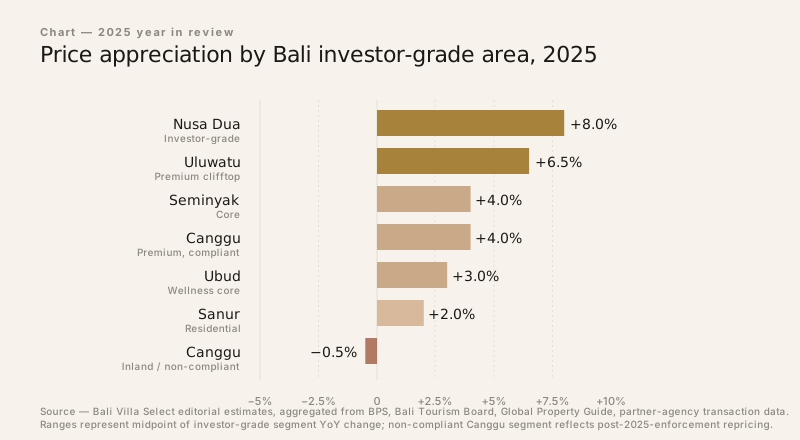
Full-year 2025 appreciation (Q1 2025 to Q4 2025 close) by investor-grade area:
| Area | YoY price appreciation 2025 | Q4 2025 gross yield |
|---|---|---|
| Nusa Dua (investor-grade villas) | +6 to +9% | 7–10% |
| Uluwatu (premium clifftop) | +5 to +8% | 9–12% |
| Seminyak (core) | +3 to +5% | 9–11% |
| Canggu (premium Berawa / Echo Beach) | +3 to +5% | 11–13% |
| Canggu (inland / Babakan) | -1 to +2% (mixed) | 8–11% |
The Nusa Dua premium that had been building through 2024–2025 became quantifiable in the Q4 data. While headline yields remained lower than Canggu's, risk-adjusted returns favored Nusa Dua for buyers prioritizing capital preservation – a thesis we develop in the Nusa Dua investment guide.
Currency and macro backdrop
Q4 2025 IDR/USD continued the Q3 pattern of moderate IDR weakness, trending in the 16,200–16,800 IDR/USD range per Bank of Indonesia data. The cumulative 2025 IDR weakness against the USD was on the order of 3–5%, which provided a modest USD-cost tailwind for Americas-based investors.
Global macro factors relevant to Bali property flow included:
- US rate environment shifted marginally (Fed pause/ease signals in Q4)
- European capital flight continued from higher-tax markets
- Australian rate environment remained stable; Australian buyer flow consistent
Foreign buyer flow Q4
Foreign buyer origin in Q4 2025 (approximate relative shares of transaction volume in investor-grade villa segment):
- Australia: ~30–35%
- Europe (DE, NL, UK, other): ~20–25%
- North America (US + Canada): ~15–20%
- Russia / CIS: ~10–15%
- Asia (SG, HK, TW): ~8–12%
- Other: balance
The PT PMA share of transactions increased through Q4 as the licensing story made commercial-rental structuring increasingly attractive versus the personal-use-only constraint of pure leasehold. See our PMA vs leasehold decision framework for the structural choice.
Notable Q4 events
Several Q4 2025 developments shaped the investor narrative:
- Canggu enforcement second wave (October–November 2025) – the most consequential regulatory development
- Nusa Dua ITDC year-end review – the development corporation published its annual retrospective reinforcing the controlled-zone character
- Digital-nomad visa policy evolution – signals continued through Q4 toward simplified foreign-resident frameworks (landed materially in H1 2026)
- Global Property Guide mid-cycle update – independent data confirmed Bali's position in the top-three-yield SE Asia markets
- Chinese New Year 2026 pre-booking – advance villa reservations for CNY 2026 (mid-February) were strong through November, supporting pricing
Implications for investors
Viewed from mid-2026, Q4 2025 crystallized three investor lessons:
- Licensing became a pricing factor, not just a risk. The spread between compliant and non-compliant villa valuations widened meaningfully – buyers who had invested in compliance through 2024–Q3 2025 saw their premium confirmed.
- Nusa Dua's risk-adjusted thesis won the year. Headline yield was never its argument; capital preservation was. Q4's divergence data made the case numerically.
- Behavioral rotation accelerated. Foreign buyer sentiment visibly rotated toward compliant, zoning-clear assets – a shift that set up the 2026 market character.
The strategic picture at Q4 2025 close: Bali had entered its "compliance era." Investors who accepted that and built it into their acquisition process moving forward were well-positioned. Those still looking for cheap-and-gray-area inventory faced a progressively harder path.
Related analysis
- Bali Property Market Retrospective: Q3 2025 – the preceding quarter
- Bali Property Market Retrospective: Q1 2026 – the following quarter
- Bali 2025 Year in Review – full-year analytical summary
- Canggu Property Investment Guide 2026 – how the licensing enforcement reshaped the area
- Nusa Dua Property Investment Guide – the structural-premium story developed
- Q2 2026 Bali property market report
- Book a 1:1 investor briefing with the editorial desk
Frequently Asked
What happened to Bali tourism in Q4 2025?
Q4 is traditionally Bali's peak season. October and November arrivals ran at or above the 2019 baseline, and December holiday demand held strong. Occupancy in investor-grade villas reached 80–95% across prime zones during peak weeks.
How much did Canggu licensing enforcement affect the market?
The second wave of compliance notices in October and November 2025 caused material disruption for non-compliant operators – several dozen visible properties temporarily paused Airbnb listings to address licensing. Pricing on non-compliant villas began softening 5–8% through late Q4 as the risk premium became visible.
Was Nusa Dua really safer than Canggu in Q4 2025?
Yes, visibly. Nusa Dua's master-planned zoning insulated it entirely from the Canggu licensing enforcement narrative. Year-over-year Nusa Dua price appreciation in investor-grade villas trended 6–9%, compared to Canggu's 2–4% average with significant sub-zone variance.
Did Q4 2025 see any major policy changes?
No single dramatic regulatory change landed, but the cumulative enforcement signal against unlicensed rentals intensified. Several announced ordinance reviews pointed toward 2026 tightening of Pondok Wisata licensing requirements.
What should Q4 2025 have told investors?
Three things: compliance matters and will matter more, area selection must factor zoning stability, and Nusa Dua deserved a closer look than its lower headline yield suggested.
Sources
- Statistics Indonesia (BPS) – Bali tourism statisticsaccessed May 12, 2026
- Bali Tourism Boardaccessed May 12, 2026
- Indonesia Tourism Development Corporation (ITDC)accessed May 12, 2026
- Bank of Indonesia – exchange rate dataaccessed May 12, 2026
- Indonesian Agrarian Ministry (ATR/BPN)accessed May 12, 2026
- Wikipedia – Tourism in Indonesiaaccessed April 25, 2026