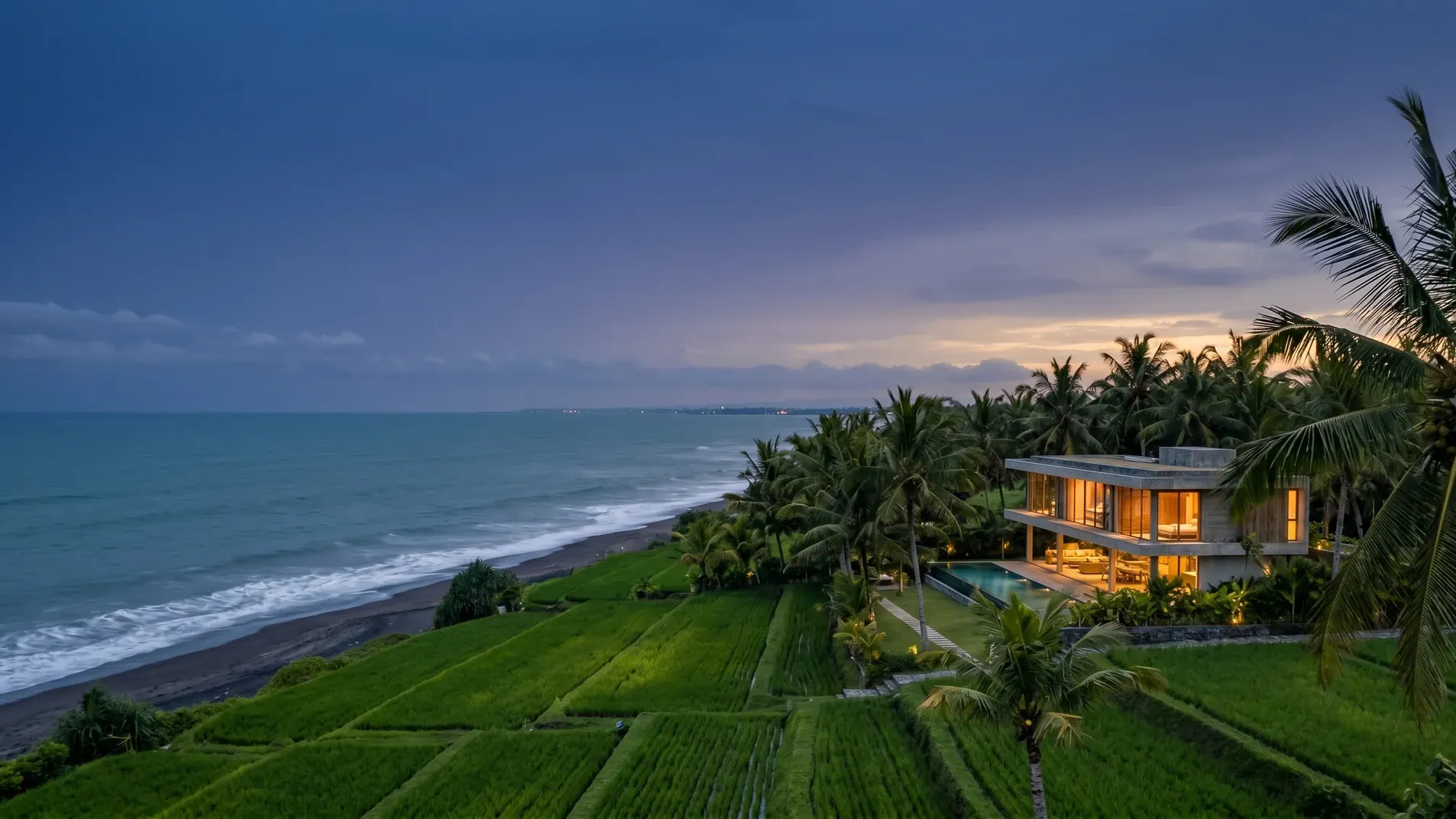
Badung · West coast
Canggu, after the licence reset.
The island's highest-yield corridor is also its most enforced. We read which side of the compliance line a villa sits on before anyone signs.
Informational material · Not a sales call · Editorial reply, not a broker pitch
Entry band
$320k–$650k
single villa, 200–350 m² built
Price / m²
$1,600–$2,800
built area, 2026 desk reads
Gross yield
8–14%
before fees, occupancy 65–85%
Net yield (est.)
5–9%
after manager + utilities + tax
ADR range
$220–$380
peak vs shoulder spread
Risk profile
Medium · licensing enforcement watchlist
Source-tier breakdown: BPS · BKPM · platform statements · editorial diligence. Methodology → · Cited by →
Informational material · Not a sales call · Editorial reply, not a broker pitch
The qualifier
Whether Canggu is your corridor.
For investors who
Canggu rewards
- buy for net yield above 8% and accept Canggu's regulatory headline risk
- want a single villa to operate themselves through STR platforms
- underwrite to 70% occupancy and reject sponsor decks quoting 85%
- treat compliance as an asset and will pay for a clean, licensed title
Not for investors who
Canggu punishes
- want hands-off ownership without a PMA and a manager structure
- are buying for capital appreciation alone – price growth lags Nusa Dua
- are uncomfortable with permit timelines that stretched 6–9 months in 2025–26
- need certainty of supply quality in a corridor still absorbing 2022–23 build-out
The micro-map
Sub-corridors of Canggu.
The corridor name hides sub-markets that diverge on price, supply quality, and risk character.
Compliant-premium
Berawa
The matured, beach-club core. Walkability and brand gravity sustain rate, and the compliant tier here now prices at a clear premium to the corridor median.
Discount supply
Echo Beach
Surf-led demand with deeper inventory. More 2022–23 product means softer ADR at the low end, but the entry band is the most forgiving in Canggu.
Frontier
Pererenan
The inland edge that is no longer the cheaper Canggu. Build prices have closed within twelve months; the verified yield gap still tilts inland.
Residential-quiet
Tumbak Bayuh
Rice-field interior favoured by longer-stay tenants. Lower nightly rate, steadier occupancy, and the lightest exposure to the K1 enforcement cases.
Recent comparables
What actually transacted.
Anonymised signed comps the desk read this quarter. The structure is the point: tenure, size, and the note the brochure omits.
| Quarter | Sub-corridor | Size built / land | Tenure | Price | $/m² | Editorial note |
|---|---|---|---|---|---|---|
| Q1 2026 | Berawa | 220 / 380 m² | Leasehold 27 yr · extension clause | $520k | $2,360 | Distressed-flip; 6-month hold by prior buyer |
| Q1 2026 | Pererenan | 180 / 300 m² | Leasehold 25 yr | $410k | $2,278 | Off-plan completion; compliant PBG in hand |
| Q4 2025 | Echo Beach | 160 / 250 m² | Leasehold 22 yr | $315k | $1,969 | K1 zoning flag; sold below ask after disclosure |
| Q4 2025 | Berawa | 300 / 450 m² | Hak Milik via PMA–HGB | $840k | $2,800 | Branded-manager leaseback; 9% guaranteed yr 1 |
| Q4 2025 | Tumbak Bayuh | 240 / 500 m² | Leasehold 30 yr | $465k | $1,938 | Long-stay tenanted; vendor financing portion |
| Q3 2025 | Pererenan | 210 / 340 m² | Leasehold 28 yr · extension clause | $498k | $2,371 | Repriced twice; final 8% under first ask |
- Size
- 220 / 380 m²
- Tenure
- Leasehold 27 yr · extension clause
- $/m²
- $2,360
Distressed-flip; 6-month hold by prior buyer
- Size
- 180 / 300 m²
- Tenure
- Leasehold 25 yr
- $/m²
- $2,278
Off-plan completion; compliant PBG in hand
- Size
- 160 / 250 m²
- Tenure
- Leasehold 22 yr
- $/m²
- $1,969
K1 zoning flag; sold below ask after disclosure
- Size
- 300 / 450 m²
- Tenure
- Hak Milik via PMA–HGB
- $/m²
- $2,800
Branded-manager leaseback; 9% guaranteed yr 1
- Size
- 240 / 500 m²
- Tenure
- Leasehold 30 yr
- $/m²
- $1,938
Long-stay tenanted; vendor financing portion
- Size
- 210 / 340 m²
- Tenure
- Leasehold 28 yr · extension clause
- $/m²
- $2,371
Repriced twice; final 8% under first ask
6 of 23 transactions the desk read this quarter in this corridor. Full quarterly comp set in the Q2 2026 Market Report →
The licensing read
Regulatory landscape
RTRW zoning across Canggu permits short-term rental in the K2 (commercial) and K3 (mixed-use) sub-zones, but K1 (residential-only) and certain coastal-setback zones do not. As of late 2025, regional enforcement has prioritised K1 cases, and a villa's sub-zone is now the first thing the desk verifies on any Canggu listing.
The licensing path runs through Pondok Wisata for the small-villa tier, but the regency backlog has stretched typical time-to-permit to six to nine months through 2025–26. Compliant inventory that already holds a PBG and an operating licence is repricing upward as a result, because it removes that wait from the buyer's underwriting.
Tenure mix in foreign-relevant inventory runs roughly 60% leasehold (typical 25–30 year terms, Hak Sewa), 30% Hak Milik held through a PMA–HGB structure, and roughly 10% direct freehold that is rarely available to foreign buyers. Which structure fits depends on holding period and whether the villa is operated as a business.
Recent direction: the 2025 enforcement wave took an estimated 30%+ of non-compliant operators offline. For the foreign buyer the practical reading is in the step-by-step purchase process and the safest-area framework – both now weight compliance status more heavily than headline yield.
Boots on the ground
Operational reality
Local management runs 18–25% of revenue for a full-service mandate – bookings, guest ops, housekeeping, maintenance, and reporting. The spread is wide because scope is. The desk's reconciliation routinely finds the cheaper mandates exclude the line items (pool chemistry, garden, pest, minor repair) that quietly move net yield by two to three points.
Seasonality is severe. July–August and the December–January peak carry the year; February and the shoulder months are where unrealistic occupancy decks fall apart. Underwrite to a blended 70% and the numbers hold; underwrite to a sponsor's 85% and they do not.
Channel mix skews to Airbnb for the villa tier with Booking.com secondary, and OTA commission loads of 15–18% are typical before a direct-booking strategy matures. Direct share above 30% is the marker of a genuinely well-run asset rather than a managed average.
Infrastructure constraints are real but manageable: mains water is reliable in most of Berawa and Pererenan, less so at the rice-field fringe where tank capacity matters; power is stable; the binding constraint is traffic, which shapes both guest experience and the practical reach of a single on-site manager.
The truth the brochure leaves out
3 risks we underwrite around.
Licensing enforcement
The 2025 crackdown took 30%+ of non-compliant operators offline, and a villa in a K1 sub-zone cannot be made compliant after the fact. The exposure is binary: a clean title and the wrong zoning are not the same villa.
Why we still publish on Canggu: the compliant tier now commands a 10–15% rate premium, so verified compliance is itself the return.
Saturation in the 1–2-bed segment
The 2022–23 build-out put a wall of small inventory into Echo Beach and parts of Berawa, and ADR at the low end has been under pressure since. Generic small villas compete on price in a way larger and view-led product does not.
Why we still publish on Canggu: 3-bed-plus, walkable, and unique-position villas hold rate, and the desk reads for exactly that.
Leasehold term decay
Most Canggu inventory trades on 22–30 year leases, and the value of a short remaining term compresses faster than a straight-line model implies once the buyer pool thins below fifteen years.
Why we still publish on Canggu: an extension clause priced into the original contract neutralises most of it, and the desk checks for one first.
Editorial offer · CANGGU
Send a specific Canggu listing. The desk will read it.
We read the certificate before the brochure, reconcile twelve months of platform data, and return a written editorial note within forty-eight hours. No follow-up sequence. No mailing list. No broker handoff unless you ask for one.
Editorial review. No charge. Not a sales call. We disclose any referral relationship on the article body, never inside the dossier.
Read it against its neighbours
Where Canggu sits in the field.
Questions the desk gets
Canggu, asked directly.
Are off-plan villas in Canggu a good investment in 2026?
Off-plan buys 15–30% below completed value in exchange for construction and developer risk, and Canggu is where that trade is most tempting and most crowded — new supply concentrates in Berawa and the Pererenan border. The 2026 rules of the trade: construction-linked payment plans only (never time-linked), notarized agreements with escrow, surveyor-verified milestones, and licensing underwritten from day one — an off-plan villa that cannot obtain Pondok Wisata in its zone is a discount trap, not a deal. Verified off-plan inventory with desk-checked yields sits on our Bukit off-plan shortlist and marketplace; the payment-plan mechanics are covered in the financing guide.
Why is Canggu the highest-yield area in Bali?
Three structural reasons. First, villa-format short-term rentals dominate the corridor – villas pull 30 to 50 percent higher ADR than equivalent condo product because guests pay a premium for private pool, full kitchen, and multi-bedroom format. Second, the visitor base is globally diverse and year-round – Australian winter, European summer, North American shoulder seasons, plus a 50,000-plus digital-nomad base means low seasonality compression. Third, nightly rates held premium levels through the entire 2024 to 2026 cycle without major correction. Investor-grade Berawa and Echo Beach villas under competent management consistently return 10 to 15 percent gross, 6 to 10 percent net after operator fees, PPh Final, and OTA cuts.
What is the minimum budget for a Canggu investment villa?
Realistic entry is around $250,000 for a small 1 to 2 bedroom villa in the outer sub-zones (Babakan, Pererenan border, far Tibubeneng). Investor-grade 2 to 3 bedroom villas in Berawa or Echo Beach with private pool start around $350,000 and reach $550,000 for prime-zoning product. Beachfront and zoning-clear premium 3-bedroom villas exceed $700,000 and run into the low $1M tier. Below $250,000 in Canggu typically means compromised zoning, shared pool, or distant access to the corridor's rental demand – yields suffer and exit liquidity narrows. Add 8 to 12 percent above the headline price for BPHTB transfer tax (5 percent), notaris fees, and due diligence.
Is Canggu still a safe place to invest after 2025 enforcement?
Yes, but only for properly zoned and licensed properties. The 2025 enforcement wave targeted unlicensed short-term rentals in residential-zone villas – the Badung Regency tourism office documented over 400 properties served with cease orders or demolition notices between Q2 and Q4 2025. This is a risk foreign buyers underestimate when buying via local intermediaries who skip the zoning check. With proper due diligence (verify Pariwisata tourism zoning at the regency office, confirm Pondok Wisata licensing capability, structure via PT PMA for commercial STR scale), the corridor remains highly investable and the post-enforcement supply correction has actually tightened the rental market in favour of compliant operators.
Which Canggu sub-zone is best for investment?
Berawa consistently ranks highest for risk-adjusted return. The sub-zone has established infrastructure, the highest sustained nightly rates in the corridor ($300 to 450 ADR for premium 2-bedroom villas), mature international guest base, and the strongest exit liquidity at the $400,000 to 700,000 price tier. Echo Beach and Pererenan border offer higher appreciation upside (10 to 18 percent annualised over the 2023 to 2026 window) with higher volatility – the 2025 licensing reset hit these sub-zones harder than Berawa. Batu Bolong and Padang Linjong sit closer to original Canggu village and suit lifestyle buyers with mixed rental intent. Avoid pure residential zones (most of inner Tibubeneng) for STR-focused investment.
Should I buy in Canggu or Nusa Dua?
Canggu and Nusa Dua solve different problems and suit different investor profiles. Canggu maximises yield (10 to 15 percent gross) but carries higher operating volatility, regulatory risk on licensing, and seasonality compression on the shoulder. Nusa Dua optimises for risk-adjusted preservation (7 to 10 percent gross, lower realised yield but materially lower volatility), institutional ITDC zoning with no surprise enforcement, and the cleanest title environment on Bali. Capital allocation rule of thumb: yield-extractive investors with active management capacity favour Canggu; preservation-focused or first-time foreign investors favour Nusa Dua. See the full corridor allocation framework in our Nusa Dua vs Canggu comparison.
Can foreigners rent out Canggu villas legally?
Only with proper licensing. Commercial short-term rental at scale requires a PT PMA Indonesian foreign-owned company holding a Pondok Wisata tourism accommodation licence, issued by the Badung Regency tourism office. Setup runs $4,000 to 8,000 plus $2,000 to 4,000 annual compliance. Personal-occasional rental from a leasehold villa (under 90 days per year, single property, no operator) is a gray area the 2025 enforcement wave has highlighted but not definitively resolved. The post-Perda 4/2026 regulatory environment is moving toward stricter enforcement on undeclared rental income across all foreign-held property. Default position: if you intend to rent commercially, set up the PT PMA structure at purchase and licence the property properly – the retrospective fix is materially more expensive than the upfront setup.
The editorial trail
Related reading
This area read is updated quarterly. Last review: 15 April 2026. Next scheduled review: 15 July 2026. Material new licensing rulings or transaction-data shifts trigger interim updates. How we update articles →