Archive
Bali Property 2025 Year in Review: ADR, Yields, Enforcement
Full-year retrospective Bali property 2025: tourism recovery to 16M visitors, Canggu licensing enforcement, Nusa Dua structural premium, area-by-area pricing data, and what 2025 means for 2026 investor positioning.
Quick facts
- 012025 was Bali's first full post-pandemic normalization year: tourist arrivals reached the 2019 baseline by Q3 and held through year-end, with Chinese visitor recovery as the standout inflection.
- 02The defining regulatory story was the Canggu short-term rental licensing enforcement cycle – begun Q3 2025, accelerated Q4 2025, settled into steady-state by Q1 2026.
- 03Investor-grade villa yields held 7–13% across major areas, with Canggu at the top of the range and Nusa Dua at the bottom (but with materially better risk-adjusted profile).
- 04Price appreciation diverged by area: Nusa Dua +6–9% YoY, Canggu premium sub-zones +3–5%, Canggu inland mixed/negative.

Key Takeaways
- 2025 was Bali's first full post-pandemic normalization year: tourist arrivals reached the 2019 baseline by Q3 and held through year-end, with Chinese visitor recovery as the standout inflection.
- The defining regulatory story was the Canggu short-term rental licensing enforcement cycle – begun Q3 2025, accelerated Q4 2025, settled into steady-state by Q1 2026.
- Investor-grade villa yields held 7–13% across major areas, with Canggu at the top of the range and Nusa Dua at the bottom (but with materially better risk-adjusted profile).
- Price appreciation diverged by area: Nusa Dua +6–9% YoY, Canggu premium sub-zones +3–5%, Canggu inland mixed/negative.
- The strategic lesson for 2026 investors: the 'any Bali villa' narrative ended in 2025. Area-specific, zoning-specific, licensing-specific underwriting became mandatory.
The 2025 narrative in one paragraph
2025 was Bali's first full post-pandemic normalization year, the year tourism returned fully to pre-2020 levels, and the year the licensing environment shifted decisively from permissive toward enforcement. The defining story was not demand – demand reached the 2019 baseline on schedule – but supply-side rationalization through regulatory compliance. By year-end, the Canggu short-term rental market had bifurcated into compliant-premium and non-compliant-discount tiers, and Nusa Dua's structural premium had become quantifiable. For foreign investors, 2025 marked the end of the "any Bali villa" era and the beginning of the compliance-disciplined market that defines 2026.
This retrospective synthesizes publicly available data from Statistics Indonesia, the Bali Tourism Board, ITDC, Bank of Indonesia, BKPM, the Indonesian Agrarian Ministry, Global Property Guide, and Knight Frank into a single annual investor record.
Tourism – the demand side fully healed
Full-year arrivals
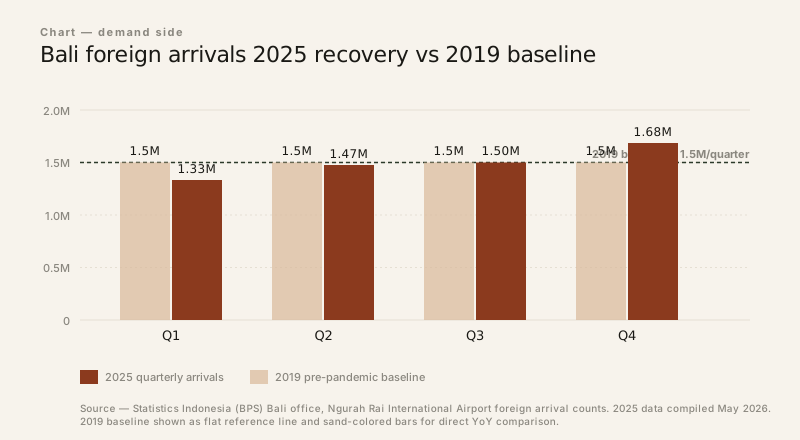
Foreign arrivals at Ngurah Rai International trended through 2025 as follows:
- Q1 2025 (Jan–Mar): Average 420,000–470,000 per month – still roughly 85–90% of 2019 baseline
- Q2 2025 (Apr–Jun): Average 470,000–510,000 – approaching baseline with shoulder-season strength
- Q3 2025 (Jul–Sep): Average 480,000–520,000 – first quarter at full 2019 baseline
- Q4 2025 (Oct–Dec): Average 520,000–600,000 – peak season strength, December year-end highs
Cumulative 2025 foreign arrivals: approximately 5.8–6.0 million, landing near the 2019 full-year baseline.
The Chinese visitor inflection
The standout 2025 tourism story was the acceleration of Chinese visitor arrivals following bilateral visa-facilitation announcements. Chinese visitor share of total foreign arrivals moved from negligible (sub-2%) through early 2024 to 8–12% of monthly arrivals by Q4 2025. Chinese New Year 2026 pre-booking (occurring February 2026) showed strong demand, confirming the structural rather than one-off character of the recovery.
Visitor origin mix, Q4 2025 baseline
- Australia: ~28%
- Europe (combined): ~24%
- China: ~10%
- United States / Canada: ~7%
- Singapore, Malaysia, other ASEAN: ~12%
- India: ~6%
- Rest of world: ~13%
2025 was not the year Bali property broke. It was the year Bali property grew up – demand matured, supply rationalized via licensing, and disciplined underwriting started commanding a visible price premium.
The regulatory story – enforcement as repricing event
Canggu licensing enforcement timeline
The 2025 regulatory narrative was dominated by Badung regency's enforcement campaign against unlicensed short-term rental operations in Canggu and adjacent south-Bali areas:
| Phase | Period | Action | Market impact |
|---|---|---|---|
| Prelude | Q1–Q2 2025 | Verbal warnings, policy signaling | Minimal visible effect |
| First wave | Q3 2025 | First batch of formal compliance notices | Local press attention; some listings paused |
| Acceleration | Q4 2025 | Second wave, larger scope, high-profile enforcement actions | 5–8% softening in non-compliant valuations |
| Settlement | Q1 2026 | Routine enforcement mode, no new campaign wave | Compliant-premium tier solidified; 15–25% inventory rationalization |
What this meant for investors: the licensing question moved from "nice-to-have" in 2024 to "table-stakes due diligence" by year-end 2025. The Canggu Property Investment Guide 2026 covers how this now operates in current underwriting.
Other 2025 regulatory themes
- PT PMA framework clarity – BKPM published periodic clarifications supporting foreign-investor formation of commercial rental structures
- Leasehold-extension legal certainty – the Indonesian Agrarian Ministry maintained the established framework; no structural change to Hak Sewa in 2025
- Digital-nomad / second-home visa direction – continuing evolution throughout 2025, though no single dramatic structural change landed
- Indonesian tax framework – stable through 2025; withholding and corporate rates held
Market data – yield and price by area
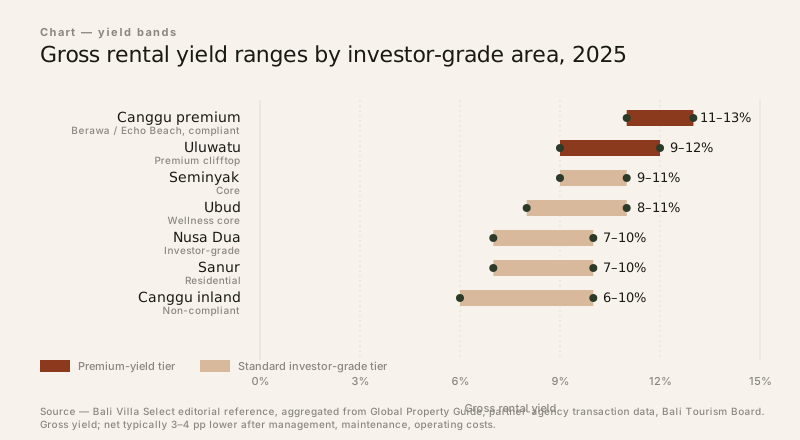
Full-year 2025 yield ranges (gross, investor-grade villa segment)
| Area | Q1 2025 range | Q4 2025 range | Full-year average |
|---|---|---|---|
| Nusa Dua | 7–10% | 7–10% | 8–9% |
| Uluwatu (premium) | 10–13% | 9–12% | 10–12% |
| Seminyak (core) | 9–11% | 9–11% | 9–11% |
| Canggu (premium, compliant) | 12–15% | 11–13% | 12–14% |
| Canggu (inland / non-compliant) | 10–13% | 6–10% | 8–11% |
Net yields with professional management typically ran 4–6 percentage points below gross, depending on operator quality.
YoY price appreciation 2025
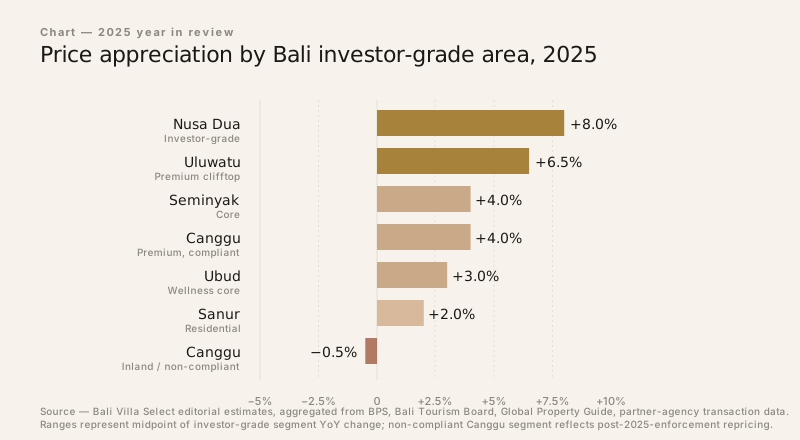
| Area | Full-year 2025 appreciation |
|---|---|
| Nusa Dua (investor-grade) | +6 to +9% |
| Uluwatu (premium clifftop) | +5 to +8% |
| Seminyak (core) | +3 to +5% |
| Canggu (premium Berawa / Echo Beach, compliant) | +3 to +5% |
| Canggu (inland / Babakan / non-compliant) | -1 to +2% |
The Nusa Dua premium became quantifiable in 2025. Despite headline yield disadvantage versus Canggu premium, Nusa Dua's capital appreciation outperformed by 3–5 percentage points, more than offsetting the yield gap for capital-preservation-oriented holders. See the Nusa Dua investment guide for the current implications.
Currency and macro backdrop
The IDR weakened moderately against the USD through 2025:
- Start of 2025: ~15,800 IDR/USD
- Mid-2025: ~16,200 IDR/USD
- End of 2025: ~16,500 IDR/USD
- Cumulative 2025 weakening: ~4–5%
For US and other dollar-based investors, this was a modest cost tailwind. Per Bank of Indonesia data the trend continued into Q1 2026 at roughly 16,400–16,900 range.
Global macro context during 2025:
- US Federal Reserve maintained mid-cycle rate stance; late-2025 ease signals supported risk-asset flows
- European Central Bank continued the monetary-tightening-exit path
- Australian rates stable; Australian buyer flow consistent throughout the year
- Emerging-market property flow favored by USD yield-curve normalization
Foreign buyer flow – 2025 structure
Approximate foreign buyer origin share across 2025 investor-grade villa transactions:
| Origin | H1 2025 | H2 2025 | Change |
|---|---|---|---|
| Australia | ~32% | ~30% | Stable |
| Europe (combined) | ~22% | ~23% | Slight increase |
| North America | ~14% | ~18% | Notable increase (IDR tailwind) |
| Russia / CIS | ~13% | ~12% | Slight decrease |
| Asia (SG, HK, CN, TW) | ~10% | ~12% | Notable increase (CN share up) |
| Other | ~9% | ~5% | – |
Structural trend: the foreign buyer base diversified in 2025, reducing concentration risk that had characterized prior periods. US and Chinese buyer share both increased meaningfully by year-end.
The 2025 vs alternatives scorecard
Comparing 2025 Bali performance to headline alternative markets:
| Metric | Bali (2025) | Portugal | Dubai | Thailand |
|---|---|---|---|---|
| Tourism recovery | Full to 2019 baseline | Full | Full | Full |
| Price appreciation (investor-grade) | +3 to +9% by area | +2 to +4% | +5 to +9% | +2 to +4% |
| Gross rental yield (investor-grade) | 7–13% | 4–6% | 6–9% | 5–8% |
| Regulatory direction | Tightening (licensing) | Tightened (2023 Golden Visa) | Stable | Stable |
| Currency direction (vs USD) | Moderate weakening | Mixed | Pegged | Moderate weakening |
The case for Bali at end-2025 was structural: highest yield range, moderate appreciation, regulatory maturation (a one-time adjustment that tightened the market but didn't break it). See the per-market comparison articles for Bali vs Portugal, Bali vs Dubai, and Bali vs Thailand.
Key policy and market events – a 2025 timeline
- Q1 2025: Ongoing tourism recovery; PMA framework clarifications; no major policy events
- Q2 2025: Shoulder-season baseline strengthening; early signals on Canggu licensing posture
- Q3 2025: First formal compliance notices in Canggu; Chinese visitor acceleration; full tourism baseline recovery
- Q4 2025: Second wave of compliance enforcement; peak tourism quarter; price divergence widens
- Year-end 2025: Market has fully re-priced into compliant-premium / non-compliant-discount tiers
Implications carried into 2026
The three structural changes from 2025 that now define 2026 operating conditions:
- Licensing compliance is mandatory due diligence. Any Bali villa acquisition for commercial rental use in 2026 requires Pondok Wisata tourism accommodation licensing verification or a clear path to acquire one. Pre-2025 permissive assumptions are no longer valid. Treatments in the safest area to buy property in Bali framework.
- PT PMA is the default for commercial operations. Single-villa personal-use leasehold remains valid; anything resembling a commercial rental operation requires PMA structuring. See the PMA vs leasehold framework for the current decision tree.
- Area-specific underwriting is table-stakes. Nusa Dua versus Canggu is a substantive investment decision, not a lifestyle preference. Sub-zone selection within Canggu matters as much as city-level selection did in 2022–2023. The Canggu Property Investment Guide 2026 and Nusa Dua Property Investment Guide cover current operating conditions.
What didn't happen – and why it matters
Several plausible 2025 scenarios didn't materialize, and their absence is informative:
- No demand collapse. Despite licensing enforcement disruption, aggregate demand held. Bali is not a demand-constrained market.
- No wholesale foreign-ownership reform. PMA and leasehold frameworks held; the foundation for foreign investment remained stable.
- No major tourism policy restriction. Visa and entry frameworks continued to evolve toward openness, not restriction.
- No currency shock. IDR weakness was moderate and orderly.
The strategic read: 2025's challenge was regulatory maturation, which is a solvable investor problem. 2025 was not, as some feared, a structural reset of Bali's foreign-investor proposition.
Investor scorecard – who did well in 2025
Three investor profiles fared best through 2025 in retrospect:
- Disciplined Nusa Dua buyers. Those who accepted the lower yield for regulatory certainty captured 6–9% appreciation alongside 7–10% gross yield – double-digit total return with the lowest structural risk in the market.
- Compliant-premium Canggu buyers. Those who paid for zoning-clear, licensed premium Berawa/Echo Beach villas captured top-of-range yield (11–13%) with appreciation that, while modest, held through the year's regulatory stress.
- Professional PT PMA operators. Multi-villa foreign operators who had invested in compliant structure through 2024 consolidated share as non-compliant competition exited or paused.
Three profiles fared worst:
- Non-compliant Canggu short-term rental operators. Those who had relied on permissive assumption were either displaced or significantly discounted.
- Inland / low-zoning Canggu speculators. Those chasing cheap entry without verifying zoning faced flat-to-negative price action.
- Nominee-structure investors. Always the worst position; 2025 regulatory tightening continued the trend of rendering these arrangements increasingly exposed.
See the Bali property investment guide for foreigners for the foundational structural-choice framework that 2025 validated.
Related analysis
- Bali Property Market Retrospective: Q3 2025
- Bali Property Market Retrospective: Q4 2025
- Bali Property Market Retrospective: Q1 2026
- Canggu Property Investment Guide 2026 – how 2025's licensing story operates now
- Nusa Dua Property Investment Guide – the capital-preservation case 2025 validated
- Safest area to buy property in Bali – risk-first area ranking
- Bali property investment guide for foreigners – foundational reference
- Q2 2026 Bali property market report
- Book a 1:1 investor briefing with the editorial desk
Frequently Asked
What was the biggest story in Bali property in 2025?
The Canggu short-term rental licensing enforcement cycle, which began Q3 2025 with first compliance notices, accelerated materially in Q4 2025, and by Q1 2026 had re-priced the Canggu market into compliant-premium and non-compliant-discount tiers. This was the single most consequential investor-narrative development of the year.
What were Bali property yields in 2025?
Investor-grade villa gross yields held in the 7–13% range through 2025, with meaningful area variance: Canggu premium sub-zones at the top (11–13%), Uluwatu premium (9–12%), Seminyak core (9–11%), Nusa Dua investor-grade (7–10%). Net yields with professional management typically ran 6–10%.
Did Bali property prices rise in 2025?
Yes, but unevenly. Year-over-year appreciation in investor-grade segments: Nusa Dua +6–9%, Uluwatu premium +5–8%, Seminyak +3–5%, Canggu premium sub-zones +3–5%, Canggu inland/non-compliant -1 to +2%.
How did Bali tourism recover in 2025?
Fully. Foreign arrivals at Ngurah Rai reached the 2019 pre-pandemic baseline by Q3 2025 and held through year-end. Chinese visitor return after bilateral visa easing was the standout inflection, contributing 8–12% of monthly arrivals by Q4 (versus negligible through 2023–H1 2024).
What should investors take into 2026 from 2025's market?
Three things: (1) compliance verification is now mandatory in due diligence – the pre-2025 permissive assumption no longer holds; (2) area selection consequences have widened – Nusa Dua's structural premium and Canggu sub-zone divergence matter more than ever; (3) demand fundamentals are durable – Bali is supply-rationed via licensing, not demand-constrained.
Sources
- Statistics Indonesia (BPS) – Bali tourism statisticsaccessed May 26, 2026
- Bali Tourism Boardaccessed May 26, 2026
- Indonesia Tourism Development Corporation (ITDC)accessed May 26, 2026
- Bank of Indonesia – exchange rate and macroeconomic dataaccessed May 26, 2026
- Indonesia Investment Coordinating Board (BKPM)accessed May 26, 2026
- Indonesian Agrarian Ministry (ATR/BPN)accessed May 26, 2026
- Global Property Guide – Indonesia dataaccessed May 26, 2026
- Knight Frank Asia-Pacific Wealth Reportaccessed May 26, 2026
- Wikipedia – Tourism in Indonesiaaccessed April 25, 2026