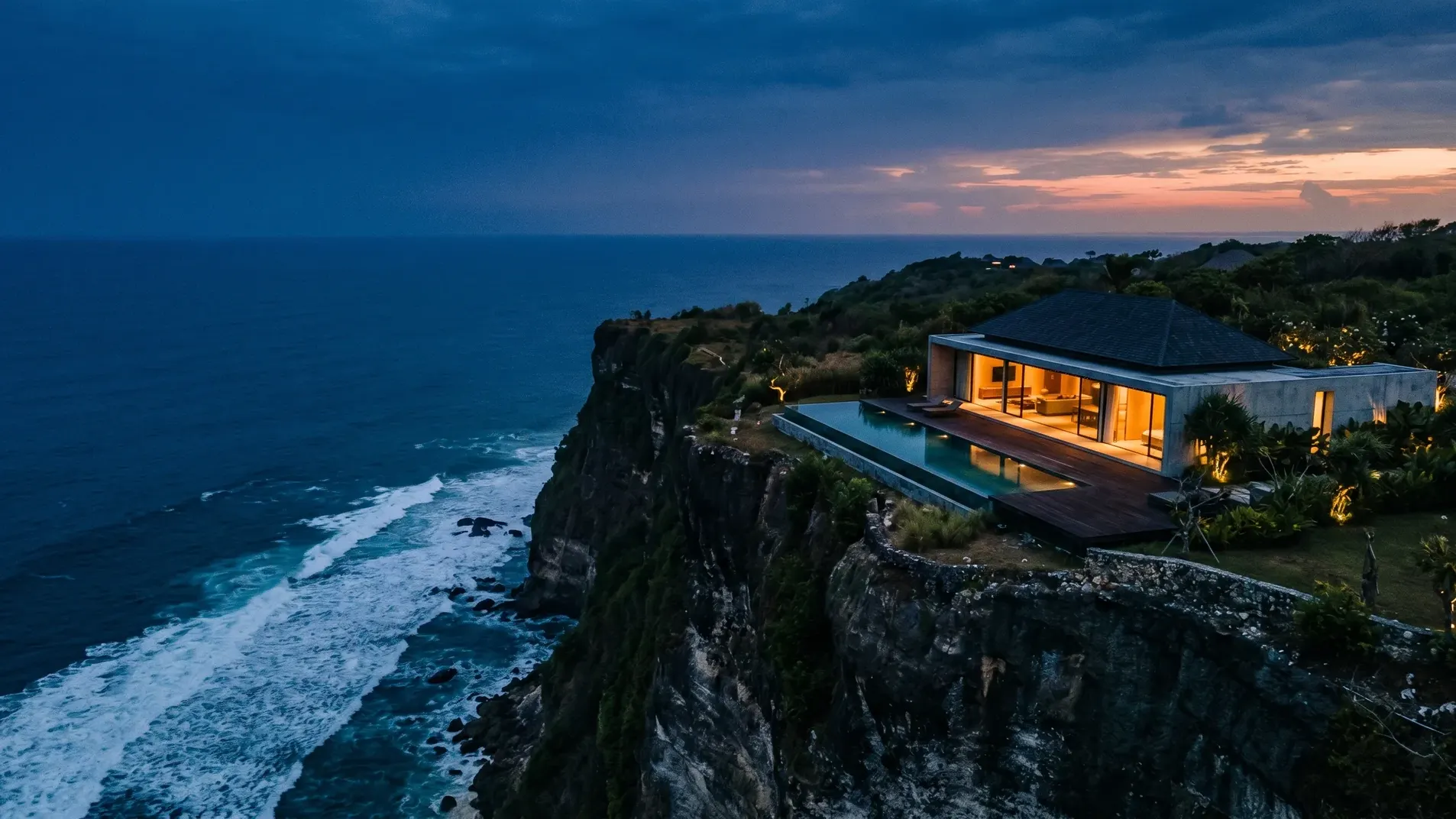
Badung · Bukit peninsula
Uluwatu, the clifftop pricing story.
The scarcest geography on the island — cliff-edge plots facing the Indian Ocean — drives Bali's strongest appreciation curve. Yields trail Canggu, volatility is lower, and the title environment is cleaner. We read which clifftop premium a villa actually earns.
Informational material · Not a sales call · Editorial reply, not a broker pitch
Entry band
$450k–$1.2M
single villa, 240–420 m² built
Price / m²
$2,200–$4,800
built area, clifftop premium tier
Gross yield
6–9%
before fees, occupancy 60–78%
Net yield (est.)
4–7%
after manager + utilities + tax
ADR range
$320–$650
premium ADR ceiling, lower occupancy
Risk profile
Medium-low · appreciation-led, cleaner title environment
Source-tier breakdown: BPS · BKPM · platform statements · editorial diligence. Methodology → · Cited by →
Informational material · Not a sales call · Editorial reply, not a broker pitch
The qualifier
Whether Uluwatu is your corridor.
For investors who
Uluwatu rewards
- underwrite to capital appreciation over 5–10 years and accept yields below the Canggu range
- are buying view-led product where the cliff edge is the asset, not the villa itself
- value title clarity and zoning predictability over headline yield maximisation
- treat resale liquidity at the premium tier as a thesis assumption, not a guarantee
Not for investors who
Uluwatu punishes
- need 10%+ gross yield to make the underwriting work — Uluwatu cannot deliver that
- want walkability and density — Uluwatu is dispersed and car-dependent
- are uncomfortable with water reliability that drops in August–October
- are buying purely for STR cashflow and have no appetite for the appreciation lock-in
The micro-map
Sub-corridors of Uluwatu.
The corridor name hides sub-markets that diverge on price, supply quality, and risk character.
Cliff-edge premium
Uluwatu clifftop
The narrow band of cliff-facing lots between Uluwatu Temple and Padang Padang. Scarcity-driven pricing, the strongest appreciation curve in Bali, and the title set here is among the cleanest on the island.
Surf-premium
Bingin
Surf-anchored clifftop core. Premium ADR holds because the swell window draws a high-spend international guest set. Smaller lots, denser supply than Uluwatu proper.
Cinematic scarcity
Padang Padang
Limited inventory, view-led pricing. Where the desk sees the highest variance between similar-looking listings — the lot's specific cliff angle does most of the pricing.
Inland discount
Pecatu interior
Off the cliff edge, where land is plentiful and entry prices drop sharply. Lifestyle villas rather than STR-yield product; the inland edge is where the Bukit story changes from appreciation to mixed-use.
Recent comparables
What actually transacted.
Anonymised signed comps the desk read this quarter. The structure is the point: tenure, size, and the note the brochure omits.
| Quarter | Sub-corridor | Size built / land | Tenure | Price | $/m² | Editorial note |
|---|---|---|---|---|---|---|
| Q2 2026 | Uluwatu clifftop | 320 / 580 m² | Leasehold 28 yr · extension clause | $985k | $3,078 | Cliff-front lot; verified PBG and operating licence |
| Q2 2026 | Bingin | 260 / 380 m² | Hak Milik via PMA–HGB | $745k | $2,865 | Branded operator leaseback; year-1 guaranteed yield |
| Q1 2026 | Padang Padang | 300 / 500 m² | Leasehold 26 yr | $1.05M | $3,500 | Limited-view cliff angle; sold at ask after rejection by prior buyer |
| Q1 2026 | Pecatu interior | 280 / 600 m² | Leasehold 30 yr | $485k | $1,732 | Lifestyle compound; long-stay portfolio buyer |
| Q4 2025 | Uluwatu clifftop | 380 / 720 m² | Hak Milik via PMA–HGB | $1.42M | $3,737 | Trophy clifftop; held 18 months by prior buyer with no rate growth |
| Q4 2025 | Bingin | 220 / 360 m² | Leasehold 24 yr | $620k | $2,818 | Short lease repriced 9% before sale |
- Size
- 320 / 580 m²
- Tenure
- Leasehold 28 yr · extension clause
- $/m²
- $3,078
Cliff-front lot; verified PBG and operating licence
- Size
- 260 / 380 m²
- Tenure
- Hak Milik via PMA–HGB
- $/m²
- $2,865
Branded operator leaseback; year-1 guaranteed yield
- Size
- 300 / 500 m²
- Tenure
- Leasehold 26 yr
- $/m²
- $3,500
Limited-view cliff angle; sold at ask after rejection by prior buyer
- Size
- 280 / 600 m²
- Tenure
- Leasehold 30 yr
- $/m²
- $1,732
Lifestyle compound; long-stay portfolio buyer
- Size
- 380 / 720 m²
- Tenure
- Hak Milik via PMA–HGB
- $/m²
- $3,737
Trophy clifftop; held 18 months by prior buyer with no rate growth
- Size
- 220 / 360 m²
- Tenure
- Leasehold 24 yr
- $/m²
- $2,818
Short lease repriced 9% before sale
6 of 17 transactions the desk read this quarter on the Bukit clifftop tier. Cross-corridor pricing reads against Canggu and Nusa Dua.
The licensing read
Regulatory landscape
Uluwatu zoning sits inside the Bukit peninsula's RTRW framework, which permits short-term rental in clearly defined tourism sub-zones along the clifftop. The K1 (residential-only) edge appears further inland; the cliff-facing band is structurally compliant for STR licensing. The desk verifies the sub-zone on every Uluwatu listing, but the discovery rate is lower than in Canggu.
Licensing through Pondok Wisata runs the standard regency path. The Bukit-side PBG backlog is shorter than central Canggu — typical time-to-permit is 5–8 months, because the operator density is lower and the regency office routes Bukit applications through a parallel queue.
Tenure mix here leans differently than Canggu — roughly 50% leasehold (typical 25–30 year terms, often with extension clauses), 35% Hak Milik through a PMA–HGB structure, and ~15% direct freehold at the >$1M premium tier. The PMA route is more common at the appreciation tier because exit liquidity benefits from the cleaner structure.
Recent direction: the 2025 enforcement wave was meaningfully lighter on Bukit than on Canggu, which validates the clifftop tier's "cleaner title environment" thesis. The desk weighs this more heavily in the safest-area framework than headline yield delta — the buyer who reads regulatory risk first gets a corridor where compliance is the default, not the work.
Boots on the ground
Operational reality
Property management mandates on the Bukit run 18–24% of revenue for the operators with cliff-tier experience. The narrow pool of competent operators here is real — the operational challenge of Bukit (water, traffic to airport, distance from suppliers) means the cheap mandates rarely deliver the verified yield. The desk has seen well-run Bukit operators hold occupancy 4–6 points above the corridor average.
Seasonality is the Bukit story's structural risk. July–August and December–January carry the year reliably; the August–October window is harder because the surf swell tapers and the water situation gets tighter (see below). Underwrite to 65% blended occupancy; the 80% sponsor decks the desk has seen for Bukit do not survive a reconciled twelve-month read.
Channel mix on the Bukit skews Airbnb at the trophy tier and Booking.com for the mid-cliff product. Direct-booking share is higher than the Canggu average — closer to 35% by year two — because the guest profile is wealthier and more relationship-oriented. The platform commission load (15–18%) bites less in dollar terms at the higher ADR.
Infrastructure constraints define the Bukit. Mains water reaches most of the cliff corridor but pressure drops sharply August–October; supplementary tank capacity is non-negotiable for any villa expecting rate-carrying occupancy. Power is stable. Traffic to Ngurah Rai airport adds 35–55 minutes depending on the day — a meaningful guest-experience variable the brochure rarely surfaces.
The truth the brochure leaves out
3 risks we underwrite around.
Water reliability August–October
Mains water pressure on the cliff corridor drops materially in the dry-season window. Villas without supplementary tank capacity face operational issues that visibly affect guest reviews and ADR sustainability — the kind of issue that does not show up in a static yield model.
Why we still publish on Uluwatu: the well-engineered Bukit villas solve this with twin-tank systems sized for the August–October pinch; the desk verifies tank capacity before yield.
Lower yield ceiling vs Canggu
Uluwatu's gross yield range tops out 3–5 percentage points below Canggu. If your underwriting model needs Canggu-level yield to clear the hurdle rate, Uluwatu cannot deliver it — and pretending it can is the single most common mistake the desk sees in Bukit listings.
Why we still publish on Uluwatu: the appreciation tier compensates over a 5–10 year hold, and the volatility-adjusted return is competitive with the Canggu top tier.
Resale liquidity at the trophy tier
Above $1.5M the buyer pool on Bukit is genuinely narrow. The desk has seen well-positioned trophy villas held 18–24 months between buyers — and the desk has also seen ones sell in four weeks at the right cliff angle. The variance is the risk.
Why we still publish on Uluwatu: the cleanest title set and the strongest appreciation curve compensate; the desk reads the specific lot before assuming any liquidity premium.
Editorial offer · ULUWATU
Send a specific Uluwatu listing. The desk will read it.
We read the certificate before the brochure, reconcile twelve months of platform data, and return a written editorial note within forty-eight hours. No follow-up sequence. No mailing list. No broker handoff unless you ask for one.
Editorial review. No charge. Not a sales call. We disclose any referral relationship on the article body, never inside the dossier.
Read it against its neighbours
Where Uluwatu sits in the field.
Questions the desk gets
Uluwatu, asked directly.
How much does an Uluwatu villa cost in 2026?
Uluwatu villas in 2026 range from $350,000 for an entry-tier 2-bedroom inland villa with shared infrastructure to $5M-plus for luxury clifftop product with direct ocean view. The investor-grade sweet spot for 2 to 3 bedroom villas with private pool runs $600,000 to $1.2M – this tier captures the bulk of foreign-buyer transaction volume and offers the cleanest yield-per-dollar ratios. Premium 3 to 4 bedroom clifftop villas trade at $1.2M to $3M, and branded-residence and ultra-luxury product (Bulgari, Aman, Six Senses-adjacent) sits at $3M to $15M-plus. The broader Bukit peninsula entry tier (Bingin inland, Pecatu, Ungasan) starts around $300,000 for smaller villas without ocean view. Add 8 to 12 percent above the headline price for BPHTB, notaris, and licensing setup.
Why is Uluwatu more expensive than other Bali areas?
Three structural reasons. First, scarcity – clifftop and direct-ocean-view land on the Bukit peninsula is structurally finite. Once the cliff frontage is built out (and the corridor is approaching that threshold), no new supply replaces it. Second, brand association – Alila Uluwatu, Bulgari Resort, Six Senses, and Aman Villas Sea Bukit established a premium baseline that anchors the entire corridor's pricing. Even non-branded villas benefit from the proximity-to-prestige effect. Third, the yield-premium combination – Uluwatu villas combine the second-highest yields in Bali (9 to 14 percent gross for properly managed product) with strong capital appreciation (8 to 14 percent annualised on prime clifftop product 2023 to 2026). This makes the per-dollar economics work even at premium prices, attracting both yield-focused and lifestyle-plus-investment buyers.
Is Uluwatu a safe place to invest in 2026?
Yes for properly zoned and licensed properties. Uluwatu has a wider range of project quality than Canggu, including some unzoned or marginally-zoned hillside developments that look attractive at brochure stage but lack proper short-term rental licensing capability. Always verify the property is in Pariwisata tourism zone (not residential), has Pondok Wisata licensing capability if STR is the investment thesis, the remaining lease term is sufficient for your hold horizon (target 27-plus years at purchase), and the access road is officially designated rather than a private easement. The 2025 licensing enforcement wave touched Uluwatu but less severely than Canggu, partly because Bukit STR licensing has historically been more concentrated in compliant operator hands. With proper due diligence, the corridor is highly investable.
Which Uluwatu sub-zone is best for investment?
Bingin and Padang Padang offer the strongest yield-per-dollar combination – mature surf-tourism rental volume, established international guest cohort, and mid-tier entry pricing ($400,000 to 750,000 for investor-grade). Pecatu and Pandawa offer higher appreciation upside with newer infrastructure and lower current ADR – good fit for buyers underwriting 5 to 7 year holds with capital-growth thesis. Pure clifftop Uluwatu (Karang Boma, Pantai Suluban) is premium hold tier with lower yield density (6 to 9 percent gross) but the strongest appreciation moat in Bali. Jimbaran sits between Bukit and Nusa Dua, with mid-range yields and strong family-tourism rental product. Nusa Dua is technically separate from the Bukit corridor and follows different demand drivers – see our dedicated Nusa Dua guide.
Can foreigners buy a villa in Uluwatu?
Foreigners cannot own Bali land under freehold (Hak Milik) – this restriction applies across Indonesia, not just Bali. The two compliant structures are: Hak Sewa leasehold (25 to 30 year terms with notarised extension clauses, $1,500 to 3,000 setup, simpler for single-property hold), or PT PMA Indonesian foreign-owned company holding Hak Guna Bangunan land rights (up to 80 years effective via 30-plus-20-plus-30 structure, $4,000 to 8,000 setup plus $2,000 to 4,000 annual compliance, required for commercial STR scale and multi-villa portfolios). Most Uluwatu transactions use leasehold for owner-occupier intent and PT PMA for portfolio or licensed STR investment. The 2026 Perda 4 nominee crackdown has made the structural choice more consequential – avoid any nominee arrangement regardless of how the broker describes the protection.
Uluwatu vs Canggu for villa investment?
The two corridors solve different problems and suit different investor profiles. Canggu wins on absolute yield (10 to 15 percent gross vs 9 to 14 percent for Uluwatu), digital-nomad-driven rental volume, urban amenity infrastructure (gyms, cafes, coworking), and entry-tier accessibility ($300,000 to 550,000 entry). Uluwatu wins on premium positioning, appreciation potential on clifftop product, lifestyle fit for buyers using the property personally during shoulder seasons, and lower regulatory risk on licensing enforcement. Canggu suits yield-extractive investors with active operator management capacity and tolerance for licensing volatility. Uluwatu suits lifestyle-plus-investment buyers with 5-plus year hold horizons and capital-appreciation thesis. Allocate by personal hold thesis – not by yield-spread arithmetic alone. See the full Canggu vs Uluwatu corridor comparison framework for the structured decision tree.
What is the realistic rental yield for Uluwatu?
Professionally managed Uluwatu villas with 60-plus percent occupancy realistically achieve 9 to 14 percent gross rental yield. Net yield after management fees (typically 15 to 25 percent of gross), OTA cuts (Airbnb 15 percent, Booking.com 12 to 18 percent), CapEx and maintenance reserves (5 to 8 percent of revenue), Pondok Wisata licensing renewal, and Indonesian PPh Final withholding tax (10 percent on rental income) typically lands at 60 to 70 percent of gross, equating to 6 to 10 percent net for actively-managed investor-grade product. Pure clifftop premium villas trade lower realised yield (7 to 10 percent gross, 4 to 7 percent net) for higher capital appreciation and lifestyle premium. Anything quoted above 14 percent net by a developer or broker should be stress-tested against operator-actual P&L on a comparable existing managed villa in the same sub-zone before signing.
The editorial trail
Related reading
This area read is updated quarterly. Last review: 13 June 2026. Next scheduled review: 13 September 2026. Material new licensing rulings or transaction-data shifts trigger interim updates. How we update articles →