Decide
Off-Plan vs Ready-Built Villa in Bali (2026): The Honest Decision Framework
Off-plan vs ready-built villa Bali (2026): the editorial decision framework – capital-appreciation upside vs fewer surprises, reported delay rates, PBG/SLF, hidden refurb costs.
Quick facts
- 01Off-plan trades discount and capital-appreciation upside against delivery risk; ready-built trades fewer surprises against a thinner uplift and an immediate refurb decision.
- 02Press coverage in 2024–25 reports roughly 38% of Bali off-plan villas missed their original delivery window (as reported), with 6–18 month slippage the most common shape – not project failure, but a cash-flow event.
- 03Off-plan only clears diligence with verified PBG (building approval) plus a credible path to SLF (suitability for use), staged payments tied to construction milestones, and three completed reference projects with handover dates.
- 04Ready-built villas carry a hidden refurb/FF&E line most buyers underestimate: figure 5–12% of purchase price on resort-class units two-plus years post-handover before they re-list at premium.
Key Takeaways
- Off-plan trades discount and capital-appreciation upside against delivery risk; ready-built trades fewer surprises against a thinner uplift and an immediate refurb decision.
- Press coverage in 2024–25 reports roughly 38% of Bali off-plan villas missed their original delivery window (as reported), with 6–18 month slippage the most common shape – not project failure, but a cash-flow event.
- Off-plan only clears diligence with verified PBG (building approval) plus a credible path to SLF (suitability for use), staged payments tied to construction milestones, and three completed reference projects with handover dates.
- Ready-built villas carry a hidden refurb/FF&E line most buyers underestimate: figure 5–12% of purchase price on resort-class units two-plus years post-handover before they re-list at premium.
- Informational, not legal advice – every off-plan or ready-built transaction is verified by an independent Indonesian notaris/PPAT before any deposit moves.
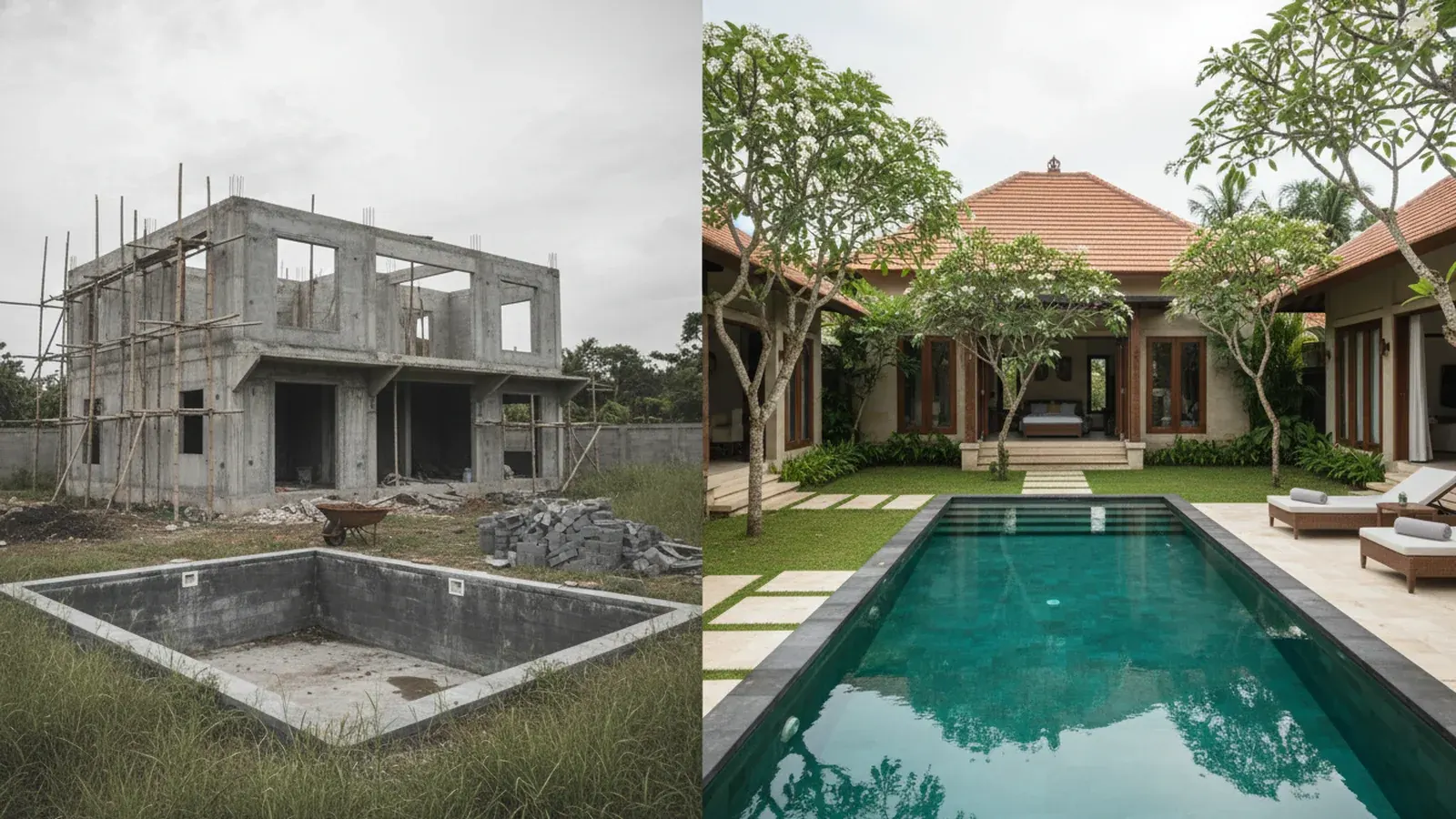
Off-plan and ready-built are not a buyer profile question, they are a risk-and-timing trade: off-plan trades discount and capital-appreciation upside against delivery risk, ready-built trades fewer surprises against a thinner uplift and an immediate refurb decision. This is the editorial decision framework. We do not sell either side of the trade, we sit on the buyer's side of the table, and the failure modes below are the ones a developer's sales deck and a resale agent's listing brochure both have an incentive to soften.
The short answer
Buy off-plan when you have 18–24 months of patience, a real appetite for capital appreciation, and a developer whose PBG (building approval), staged-payment structure, and last three completed projects all check out independently. The discount sits in the 20–35% range against the post-handover comp; the uplift in tight corridors runs another 8–15% on handover. The trade-off is delivery risk: press coverage in 2024–25 reports roughly 38% of Bali off-plan villas missed their original delivery window (as reported), with 6–18 month slippage the most common shape.
Buy ready-built when you need yield from month one, when you are buying in a corridor where off-plan stock is thin or absent, or when delivery risk is a hard no. The trade-off is the refurb line – figure 3–6% of purchase price on FF&E within two years, 8–12% on a full refresh by year four-to-five on resort-class units. Most ready-built net-yield models you will see do not show this line.
If you cannot answer the diligence checklist below, the answer is neither – do not deposit.
The off-plan case
The upside is real and quantifiable
Off-plan in Bali exists because developers need pre-sale capital to build, and because foreign buyers can underwrite a 14–28 month wait if the corridor and developer hold. The price you sign at is typically 20–35% below the eventual post-handover comp in the same corridor. In tight zones (parts of Pererenan, Bingin/Uluwatu, Ubud's premium ridges), an additional 8–15% uplift on handover is observable in 2024–25 transactions (as reported, Knight Frank Indonesia and corridor brokers). The compounding of the entry discount and the handover uplift is the structural reason patient capital still chases off-plan despite the delay headlines.
There are two other real upsides. First, you typically choose unit configuration, FF&E pack, and sometimes pool format – which makes the eventual rental product more aligned with your booking strategy than a ready-built unit you bought "as is." Second, staged payments mean the full capital is not committed at signing. In a rising-rates environment that matters; the un-deployed portion can sit in yield until the next tranche.
The risks are concentrated and checkable
The risks are not hidden, but they are concentrated in three places.
Delivery risk is the headline. Reported 2024–25 figures put roughly 38% of Bali off-plan villas behind their original window (as reported in Bali Discovery and brokerage commentary). The bulk of this is 6–18 month slippage, not outright project failure. Slippage is a cash-flow event – your first booking is pushed by a season, your underwriting yield drops for year one – but rarely a capital loss event on properly contracted projects.
Permit risk is where capital loss actually sits. PBG (Persetujuan Bangunan Gedung, the building approval) and the eventual SLF (Sertifikat Laik Fungsi, fitness for use) are the two non-negotiable documents. A villa without verified PBG at signing is not an off-plan villa, it is a brochure. Construction without PBG can be halted, fined, or in extreme corridors demolished. We do not buy these. The PBG must be a verifiable document at the relevant agency, not a screenshot.
Developer risk is the residual category – undercapitalised builders, half-finished projects sold off cheap, and the recurring pattern where pre-sale capital from project B is used to finish project A. The defence is a track record: at least three completed projects with verifiable handover dates, real reference buyers you can speak to, and a clean staged-payment structure that ties tranches to construction milestones rather than calendar dates.
The ready-built case
Predictability is the product
Ready-built villas remove three of the four risk categories of off-plan in a single signature: delivery risk, permit-timing risk, and "is the developer going to finish this" risk. You buy an asset with title, with PBG and SLF on the certificate, with a rental history (or at least a clear corridor comp), and with FF&E that you can inspect on a site visit before you wire any money. For a meaningful slice of foreign buyers – especially those buying their first Indonesian asset, those without an Indonesian operator on the ground, and those whose income from the asset has to start the month after closing – this is the only structurally honest answer.
The other predictability advantage is comp visibility. A ready-built villa in Berawa or Pererenan has neighbours with the same configuration on AirDNA, with a known occupancy and ADR curve, and an editorial corridor read you can layer on top. Off-plan, you are underwriting a forecast.
The hidden refurb and FF&E line
The honest weakness of ready-built is the cost line most buyers do not see modelled: refurb and FF&E refresh. A villa that handed over in 2022 and has run hard as a resort-class short-term rental for three peak seasons is not the villa in the listing photos. Soft furnishings, mattresses, pool equipment, AC, outdoor furniture, and often kitchen appliances are at end-of-life or visibly tired. To re-list at the premium ADR the seller's net-yield model assumed, you spend.
The directional numbers we use editorially:
- Year 2 refresh (soft FF&E, mattresses, pool, minor): 3–6% of purchase price.
- Year 4–5 refresh (above plus AC, appliances, paint, deck, often pool finish): 8–12% of purchase price on resort-class units.
- Year 7+ on a heavy-use property: a full FF&E re-spec plus selective hard renovations, 12–18% on a clean re-position.
This line is rarely shown in the seller's net-yield model. It is the single most underestimated cost in the ready-built case, and it is the reason why an honest ready-built underwriting model marks an annual 1.5–2.5% FF&E reserve against rental revenue.
There is a second hidden cost most ready-built models ignore: corridor drift. The Berawa that handed your villa in 2021 is not the Berawa that lists it in 2026 – traffic, density, and ADR ceiling all shift. Ready-built protects you from delivery risk; it does not protect you from corridor risk. That is a diligence read, not a refurb line, but it sits in the same drawer.
The reported delivery-delay data
We use "as reported" deliberately. There is no central Bali off-plan delivery registry; every figure cited in 2024–25 press coverage comes from broker association reports, developer-network surveys, and aggregated journalism. With that caveat clearly stated:
- Reported ~38% missed original handover in 2024–25 (as reported across Bali Discovery, Prestige Property Bali commentary, and corridor brokerage notes). This is the headline figure most often cited.
- Median reported slippage 6–18 months where slippage occurred. Press coverage notes that the typical pattern is sequential delays (one tranche stage slips, the next compounds), not a single catastrophic event.
- Outright failure is rarer. Project abandonment is documented but a small share of reported cases. Where it occurs, the precipitating pattern is almost always one of three: missing PBG from the start, pre-sale capital from project B funding project A, or a corridor-wide construction-cost shock the developer could not absorb.
- Cause attribution in press coverage clusters around: construction-input price moves (cement, finishing materials, imported FF&E), labour availability post-Nyepi and around major festivals, permit timing where SLF lagged structural completion, and developer working-capital gaps.
The diligence implication is straightforward. You cannot eliminate delay risk in off-plan, but you can structurally compress your exposure: verified PBG, staged payments tied to verifiable construction milestones, a contractually defined delay-and-refund clause, and three completed reference projects with handover dates you can phone-verify.
The developer diligence checklist for off-plan
Used by the desk on every off-plan brief we run. Treat it as a pre-deposit gate, not a wish list.
- PBG verified at the agency – not the developer's PDF. The notaris/PPAT you appoint independently confirms the PBG is issued for the specific plot and the specific structure you are buying.
- Title class confirmed – HGB (via PT PMA) or a properly structured leasehold. The certificate must match the marketing claim. If the developer cannot show the title until "later in the build," that is a structural answer, not a process answer.
- Three completed reference projects with handover dates – ideally in the same corridor. Phone-verifiable references, not screenshots. A developer with no completed projects is a developer with no track record, regardless of how strong the brochure is.
- Staged payments tied to verifiable construction milestones – structure, roof, finishing, handover. Photo evidence and independent site visit at each milestone. Calendar-only payment schedules push delivery risk to you, not to the developer.
- Delay-and-refund clause in the SPA – with a defined cap (typically 6–9 months) beyond which the buyer can rescind and recover deposits. This is the single most-skipped clause in Bali off-plan SPAs and the single most-protective one.
- SLF pathway – the developer has a documented track record of obtaining SLF on prior projects, and the SPA defines a deadline for SLF post structural completion. No SLF, no legitimate short-term rental operation.
- FF&E and landscaping defined – what is in the price and what is extra. Most off-plan SPAs we see exclude landscaping, exterior finishing, and a meaningful FF&E line. Pricing the full delivered product, not the structural box, is what makes the discount real or illusory.
- Funds path – payments to a verified developer corporate account at an Indonesian bank, with the notaris escrow option used on the structure-roof milestone. Crypto, personal accounts, and offshore wires for an Indonesian project are disqualifying signals.
If any of these eight is "later" or "trust us" at signing, the answer is not a renegotiation, it is a pass.
The refurb and FF&E reality for ready-built
The mirror checklist for ready-built. These are the diligence steps that pull the hidden line into the open.
- Age and FF&E condition – handover year, FF&E age, last refresh date. Walk the property with this checklist physically; photos understate wear.
- Pool, AC, and pumps – the three largest mid-life FF&E lines. Service records, replacement dates, and a visual inspection by your own technician (not the seller's).
- Rental history and wear – three peak seasons at high occupancy is materially different from three seasons at 50%. Wear scales with occupancy, not with calendar age.
- Corridor drift – traffic, density, and ADR ceiling have all moved between handover and your purchase. The corridor read on Canggu and the diligence rules in Bali property diligence apply.
- Refurb reserve in the model – 1.5–2.5% annual FF&E reserve against rental revenue is the editorial honest line. If the seller's model shows no reserve, ask for the seller's model with the reserve added and re-run the net yield.
- Structural lines – roof, retaining walls, drainage. These are corridor-specific and often invisible until the rainy season. A pre-purchase building inspection by an independent engineer is a $500–1,500 line that has saved buyers six-figure errors.
The refurb reality does not kill the ready-built case. It moves the honest net yield 1.5–3 percentage points below the seller's number, which is where the off-plan-vs-ready trade actually plays out.
The decision matrix
A directional editorial read. Use it as a starting position, not a verdict.
| Buyer profile | Budget band | Timeline | Corridor | Editorial fit |
|---|---|---|---|---|
| First Bali asset, single property, conservative | $250–500k | Yield needed in 90 days | Berawa, Sanur, Nusa Dua | Ready-built |
| Patient capital, capital-appreciation appetite | $200–400k | 18–24 month horizon | Pererenan, Bingin, Ubud ridges | Off-plan (with diligence) |
| Second/third Bali asset, operator on the ground | $400k+ | Mixed | Any | Either, by deal-by-deal |
| Resort-class repositioning, refurb-led | $500k–1.2M | 6–12 months refurb | Berawa, Seminyak, Uluwatu | Ready-built + refurb plan |
| Cash-rich, low risk tolerance, no operator | Any | Yield in 30–90 days | Tight investor zones | Ready-built |
| Yield-from-month-one with rental finance attached | $300–600k | 30 days | Any with rental history | Ready-built |
| Off-plan only by corridor scarcity | Corridor-dependent | 14–28 months | Bingin, parts of Pererenan, Ubud ridges | Off-plan (verify hard) |
The matrix runs on four inputs: budget band, timeline to first yield, risk tolerance, and corridor. Two of those (timeline and risk tolerance) carry most of the weight. The other two define the realistic stock set.
Worked example – 2BR Pererenan off-plan vs ready Berawa
A directional editorial worked example. Numbers are corridor composites used by the desk in 2026, not a specific listing. Run a real listing through the villa-analyzer for a per-property read.
Option A – 2BR off-plan villa, Pererenan, handover Q2 2027
- Headline price: $290,000
- Post-handover comp: $360,000 (estimated, in-corridor)
- Implied discount: ~19%
- Staged payments: 25% / 25% / 25% / 25% across signing, structure, finishing, handover
- Expected delay (editorial central case): 6–9 months past Q2 2027
- First yield: ~Q1 2028
- Gross yield once stabilised (2028): ~10–12% on $290k entry
- Editorial central-case capital position end of year 3: $360k market + ~$25k FF&E top-up = $385k, against $290k cost
- Reported delivery-delay probability: roughly one in three the project misses by 6+ months (as reported); diligence-cleared developers materially below that
Option B – 2BR ready-built villa, Berawa, handover 2022
- Headline price: $360,000
- Already at market; no entry discount
- Closing in 30–60 days
- Year 1 gross yield (existing rental history): ~9–11% on $360k
- Year 2 FF&E refresh: ~$15,000 (4% of price)
- Year 4–5 refresh: ~$32,000 (9% of price)
- Editorial central-case capital position end of year 3: $385k market (Berawa, slightly below Pererenan corridor growth), against $360k cost + $15k FF&E = $375k all-in
The Pererenan off-plan path delivers ~$95k of capital uplift over three years (price discount plus corridor growth, net of FF&E top-up), against ~$10k for the Berawa ready-built. The ready-built earns yield from month one – three peak seasons at ~10% gross is materially more than zero in the off-plan path. On an all-in basis the off-plan still wins for patient capital, but only if delivery clears within the delay-and-refund cap and the developer-diligence checklist is verified.
The same example with a problem developer flips the trade: a 14-month delay plus an FF&E exclusion the buyer did not catch erases the discount entirely.
This is the reason the editorial answer is "it depends on diligence, not on the brochure."
Verdict
There is no universal answer. There is a structured answer.
- Off-plan wins on numbers when diligence clears. The 20–35% discount and the 8–15% handover uplift in tight corridors are real. The delivery-delay headline (~38% in 2024–25, as reported) is also real. The first does not erase the second; staged payments, verified PBG, a real delay-and-refund clause, and three completed reference projects do.
- Ready-built wins on time and predictability. Yield from month one, zero permit timing risk, and a physical asset you can inspect. The hidden refurb/FF&E line is the honest weakness – model it at 1.5–2.5% annual reserve against rental revenue and the net yield falls in line with what the asset actually delivers over a hold period.
- The decision matrix is the right starting point, not the verdict. Budget, timeline, risk tolerance, and corridor scarcity are the four inputs. The matrix is directional editorial, not a score.
Related reads on the same shelf: Bali property diligence, the biggest Bali property scams, how to buy a villa in Bali as a foreigner step by step, PMA vs leasehold in Bali, notary and BPHTB fees, and the Canggu property investment guide.
Informational, not legal advice – every off-plan or ready-built transaction is verified by an independent Indonesian notaris/PPAT before any deposit moves.
| Dimension | Off-plan | Ready-built | Edge |
|---|---|---|---|
| Capital appreciation upside | Typically 20–35% discount to post-handover comp; 8–15% uplift on handover in tight corridors | Already at market; uplift tracks corridor, not the build | Off-plan |
| Delivery risk | Reported ~38% missed original window in 2024–25 (as reported); 6–18 mo slippage is the common shape | Zero delivery risk; physical asset on day one | Ready-built |
| Staged payments | 20–30% / 20–25% / 20–25% / 10–20% across structure-roof-finishing-handover | Single closing (with notaris escrow on professional transactions) | Tie |
| Hidden costs | FF&E and landscaping often excluded; PBG/SLF timing can delay first booking | Refurb/FF&E refresh 3–6% of price at 2 yr, 8–12% at 4–5 yr on resort-class units | Tie |
| Time to first yield | 14–28 months from signing in most cases (post-SLF and FF&E) | 30–90 days; immediate handover and re-list | Ready-built |
| Who it fits | Patient capital, capital-appreciation appetite, clean developer to verify, 18+ month horizon | Yield-from-month-one buyers, delivery-risk averse, tight corridors with no off-plan stock | Tie |
Frequently Asked
Is off-plan villa in Bali safe?
Off-plan villas in Bali are safe only when three conditions are met: PBG (building approval) is issued and verified at the agency, payments are staged against construction milestones rather than the calendar, and the developer has at least three completed handovers with verifiable dates. Press coverage reports roughly 38% of 2024–25 deliveries slipped their original window (as reported), so a written delay-and-refund clause is part of the safety, not optional.
What is off-plan vs ready-built?
Off-plan means buying a villa before construction is complete – typically at 20–35% below the post-handover price, paid in 3–5 tranches as building progresses. Ready-built means buying an existing villa with title, permits, and rental history already in place. The trade is upside and discount on one side, predictability and immediate yield on the other.
What is the Bali off-plan delivery delay rate?
As reported in 2024–25 industry press, roughly 38% of Bali off-plan villas missed their original handover date, with 6–18 month slippage the most common pattern. Outright project failure is rarer but documented; verified PBG, staged payments, and a known developer track record materially reduce the risk.
How do staged payments work in Bali off-plan?
A typical Bali off-plan schedule is 20–30% at signing, 20–25% at structure/roof, 20–25% at finishing stages, and a 10–20% balance at handover with the SLF on issue. The protection comes from tying tranches to verifiable construction milestones (photo evidence, independent site visit) rather than fixed dates, so delay shifts risk to the developer, not to you.
Do ready-built Bali villas need refurb?
Most do, eventually. A ready-built villa two-plus years post-handover typically needs an FF&E refresh (soft furnishings, mattresses, pool equipment) of 3–6% of purchase price to re-list at premium; full refurb at the 4–5 year mark runs 8–12% on resort-class units. This line is rarely shown in the seller's net-yield model and is the single most underestimated cost in the ready-built case.
Should I buy off-plan or ready-built in Bali?
Off-plan fits buyers with 18–24 month patience, capital-appreciation appetite, and a clean developer to verify – the discount and uplift compound. Ready-built fits buyers who need yield from month one, dislike delivery risk, or are buying in a tight corridor where ready stock is the only realistic entry. The decision matrix below sorts by budget, timeline, risk tolerance, and corridor.
Sources
- BKPM / Indonesia Investment Coordinating Board – foreign investment realisation, Bali (Q4 2025 brief)accessed May 22, 2026
- ATR/BPN – Indonesia land administration & PBG/SLF framework referenceaccessed May 22, 2026
- Bali Discovery – press coverage of villa-delivery delays and developer disputes 2024–25accessed May 22, 2026
- Knight Frank Indonesia – Jakarta & Bali residential market briefsaccessed May 22, 2026
- Global Property Guide – Indonesia construction-cost and residential return dataaccessed May 22, 2026
- Prestige Property Bali – risks of investing in Bali real estate (developer & PBG risk)accessed May 22, 2026