Inside Bali
Canggu vs Uluwatu Property Investment: Which Area Wins in 2026?
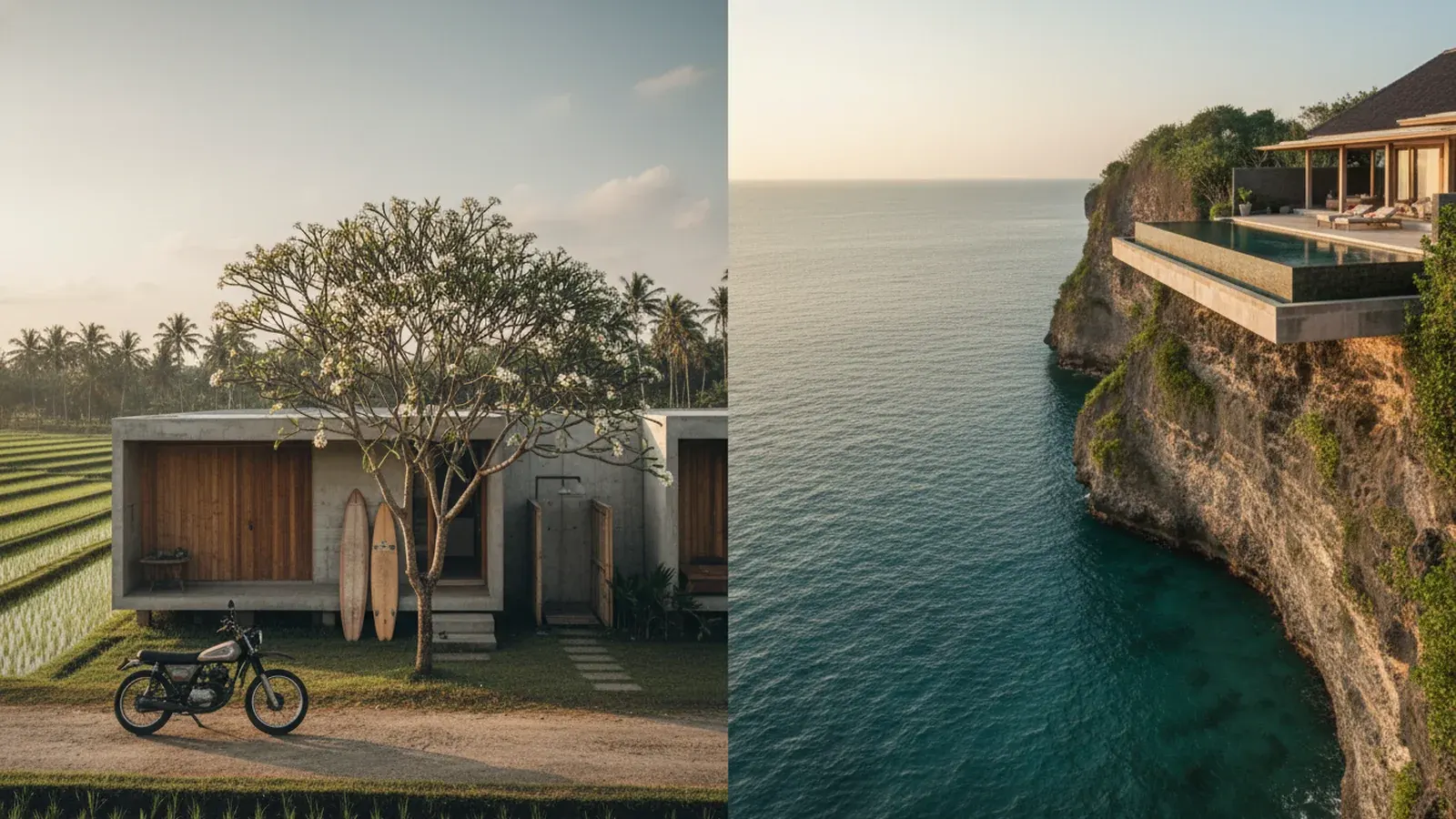
Canggu vs Uluwatu for 2026 investors – honest side-by-side on prices, yields, buyer profiles, and the quiet structural differences most comparisons miss.
Quick facts
- 01Canggu delivers the highest typical gross yields in Bali (10–15%); Uluwatu delivers the highest capital appreciation and pricing power for luxury product.
- 02Canggu entry is $250–400k for investor-grade villas; Uluwatu clifftop entry starts around $900k and climbs past $3M for prime positions.
- 03Canggu runs on short-stay volume and digital-nomad tourism; Uluwatu runs on scarcity of clifftop inventory and high-income leisure travel.
- 042025 licensing enforcement affected Canggu more materially than Uluwatu – zoning verification is now a non-negotiable in Canggu.
Key Takeaways
- Canggu delivers the highest typical gross yields in Bali (10–15%); Uluwatu delivers the highest capital appreciation and pricing power for luxury product.
- Canggu entry is $250–400k for investor-grade villas; Uluwatu clifftop entry starts around $900k and climbs past $3M for prime positions.
- Canggu runs on short-stay volume and digital-nomad tourism; Uluwatu runs on scarcity of clifftop inventory and high-income leisure travel.
- 2025 licensing enforcement affected Canggu more materially than Uluwatu – zoning verification is now a non-negotiable in Canggu.
- Which wins depends on what you are optimising: cash-flow today (Canggu) or defensible value preservation (Uluwatu).
The one-minute read
Canggu and Uluwatu are Bali's two most discussed investment corridors, and the comparison is almost always framed poorly. The question is not which is better – both are investable. The question is what you are optimising for.
If you are optimising for cash-flow today, Canggu wins on yield. Entry-level 1–2 bedroom villas at $250–400k routinely deliver 10–15% gross yields on short-term rental, with occupancy that can exceed 75% for professionally-managed units in Berawa or Echo Beach.
If you are optimising for defensible long-term value, Uluwatu wins. Clifftop inventory is genuinely scarce, pricing power has proven durable across two full cycles, and the luxury leasehold and PMA market trades with measurably tighter spreads.
This article is not going to tell you which one to buy. It is going to give you the structural basis to decide for yourself.
Why this comparison matters
Most "Canggu vs Uluwatu" content treats them as substitute products with different vibes. They are not substitute products. They address different investor motivations, attract different guest profiles, trade on different legal structures with meaningful frequency, and respond differently to macro shocks.
A buyer who lands in Canggu after researching Uluwatu is usually buying the wrong product for their stated goal, and vice versa. Before comparing price or yield, establish whether you are underwriting a cash-flow asset or a capital-preservation asset. The rest of the analysis falls out of that decision.
Canggu – the cash-flow case
Canggu is Bali's highest-yield corridor precisely because it is not its highest-prestige corridor.
Canggu's investment thesis rests on three structural facts.
First, villa-format short-stay dominates. Canggu inventory is overwhelmingly 1–4 bedroom villas with private pools, sized for 2–6 guests per booking. That format commands higher nightly ADR per bed than condo product anywhere in Bali, and Canggu has absorbed more of it than any other sub-market.
Second, the guest base is globally diverse and year-round. Australian, Russian, Singaporean, Indian, European, and American guests overlap in Canggu more evenly than anywhere else on the island. Seasonality still exists, but shoulder months bleed less than they do in Ubud or Nusa Dua. Digital-nomad long-stay bookings further fill the calendar.
Third, the supply chain is mature. Property managers, cleaning services, villa suppliers, legal counsel specialising in Pondok Wisata licensing, tax advisers – Canggu has them at scale. The operational friction on a new Canggu investment is lower than anywhere else in Bali.
Canggu price bands in 2026
| Segment | Entry price | Target yield (gross) | Typical profile |
|---|---|---|---|
| Entry (outer Canggu / Pererenan border) | $250–400k | 10–15% | 1–2 BR villa, ~150 sqm land, non-beachfront |
| Investor-grade (Berawa / Echo Beach) | $450–750k | 10–13% | 2–3 BR villa with pool, professional rental management |
| Prime (beachfront / Batu Bolong) | $800k–1.5M+ | 7–11% | 3 BR+ villa, walkable to beach, premium zoning |
| Luxury (Seseh / prime Pererenan) | $1.2M+ | 6–9% | 4 BR+ compound, architectural featured, scarce land |
Canggu's risk concentration
The 2025 licensing enforcement moved Canggu's regulatory risk from "theoretical" to "concrete." Properties without correct zoning or Pondok Wisata licensing can no longer rely on informal tolerance. If you buy in Canggu in 2026, zoning verification and legal licensing structure are due-diligence gates – not items to resolve later.
Competitive supply is the second risk. Pererenan, Nyanyi, and Kedungu have absorbed substantial new inventory through 2024–2026. If absorption slows, Canggu-wide ADR compresses before Uluwatu's does.
Uluwatu – the capital-preservation case
Uluwatu's investment thesis rests on scarcity of clifftop inventory and the pricing power that scarcity creates.
Uluwatu's story is different in kind, not degree.
Scarcity is real. True clifftop positions – villas directly above the Indian Ocean, with no setback from the cliff edge – number in the dozens across the entire Uluwatu corridor from Suluban to Nyang Nyang. Every other "ocean view" parcel in Uluwatu is one step removed: a secondary ridge, a valley position with filtered views, or a plot where the cliff is technically visible but not the defining feature of the property.
Pricing power has held. Luxury clifftop ADR in Uluwatu has moved with headline inflation and not much else since 2018. Through the 2020 shutdown, the 2022 reopening overshoot, and the 2024 normalisation, clifftop ADR compressed less than any other Bali segment. That durability is the investment thesis.
Operator sophistication matters here. The gap between an Uluwatu villa with credible hospitality operations and one without is larger than the equivalent gap in Canggu. The luxury guest segment in Uluwatu expects Four-Seasons-level service. Villas that deliver it extract a measurable premium; those that attempt it poorly underperform substantially.
Uluwatu price bands in 2026
| Segment | Entry price | Target yield (gross) | Typical profile |
|---|---|---|---|
| Non-clifftop residential | $500–900k | 6–9% | 2–3 BR villa 1–2 km inland, ocean view from upper floor |
| Sub-clifftop / cliff-adjacent | $900k–1.8M | 6–9% | Second-ridge position, partial clifftop views, reliable rental |
| True clifftop (mid) | $1.8M–3.5M | 5–8% | 3–4 BR villa directly above ocean, architectural feature |
| Ultra-luxury clifftop | $3.5M+ | 4–7% | 4 BR+ villa, premier position, branded operator or private |
Uluwatu's risk concentration
Construction and permit exposure is the first risk. Cliff-edge geology creates PBG compliance complications that do not exist in Canggu. Villas with non-compliant builds – too close to the setback, non-approved extensions, SLF missing – trade at materially discounted levels once buyers understand the exposure.
Remaining lease-term compression is the second. Many prime clifftop positions trade on leasehold, and leases assembled in the 2000s are now showing materially less remaining term than the pricing still implies. Always model remaining-term value explicitly, not as an afterthought.
Tourism concentration is the third. Uluwatu's guest base is disproportionately high-income leisure. A material pullback in that segment (2020 reopening) cost Uluwatu more operating days than it cost Canggu, where broader mid-tier tourism kept calendars partially filled.
Head-to-head – the structural comparison
| Canggu | Uluwatu | |
|---|---|---|
| Investment thesis | Cash-flow maximisation | Capital preservation + appreciation |
| Typical gross yield | 10–15% | 6–10% |
| Typical entry price | $250–400k | $500–900k (non-clifftop); $900k+ (clifftop) |
| Product format | 1–4 BR villas, pool | 2–4 BR villas, typically larger |
| Guest base | Diverse, year-round, digital-nomad heavy | Luxury leisure, Australian and regional Asian |
| Occupancy (well-managed) | 70–80% | 55–70% |
| Operational friction | Low – mature supply chain | Moderate – operator quality matters more |
| Regulatory exposure | Zoning + Pondok Wisata licensing | Cliff-edge PBG and SLF compliance |
| Appreciation durability | Moderate, supply-pressured | Strong, scarcity-supported |
| Liquidity (resale) | Thicker – more transactions | Thinner at the top, active in mid-tier |
| Best legal structure | PT PMA with Pondok Wisata or long leasehold | PT PMA with HGB or long leasehold |
Which wins for whom
Canggu wins if you:
- Want net yield to cover financing or supplement income within 12 months of acquisition
- Have $250–700k deployed, not $1M+
- Plan to use professional rental management and stay hands-off
- Accept more supply competition and more regulatory friction as the cost of higher yield
- Are building a multi-property portfolio where cash-flow compounds matter
Uluwatu wins if you:
- Are buying primarily as a store of value with rental as a secondary benefit
- Have $900k+ deployed with the capacity to carry an asset through lower-utilisation years
- Value view, privacy, and architectural feature over rental frequency
- Want a more defensible resale position when you exit
- Are willing to accept construction and lease-term diligence as a higher upfront cost
Do both is also a legitimate answer. Portfolio investors with $2M+ frequently pair one Canggu yield unit with one Uluwatu position-asset. The blended portfolio yield lands around 8–10% gross with a materially stronger resale story than either one alone.
The 2026 outlook
We see three signals worth watching through the rest of the year.
Canggu supply absorption. The Pererenan and Kedungu pipelines will test whether Canggu mid-tier ADR compresses materially. Two quarters of ADR softening would change the yield math across the corridor.
Uluwatu lease-term repricing. As leases assembled in the 2000s approach 2030s expiry windows, we expect transaction pricing to adjust to remaining-term mathematics faster than brokers currently signal. Buyers should now be pricing against forward-looking years, not historical comparables.
Licensing enforcement durability. If 2025 Pondok Wisata enforcement sustains through 2026, Canggu's risk-adjusted yield gap versus Uluwatu narrows slightly – compliant operators will see benefit, non-compliant operators are already discounted. If enforcement weakens, the Canggu yield advantage widens again.
Final read
Canggu delivers cash-flow. Uluwatu delivers capital preservation. Neither is better – they solve different problems.
If you cannot decide which problem you are solving, you are not ready to buy in either. Start with the decision: are you underwriting yield or preservation? The area follows.
Take action
Frequently Asked
Which has higher rental yield, Canggu or Uluwatu?
Canggu, consistently. Investor-grade Canggu villas deliver 10–15% gross yields; Uluwatu runs 6–10% gross. The reason is not demand – it is volume: Canggu turns over nightly bookings faster across a broader guest base, while Uluwatu's luxury segment accepts more gap nights between bookings.
Which area has better capital appreciation?
Uluwatu, by a measurable margin. Clifftop land in Uluwatu is genuinely scarce – perhaps three dozen true clifftop plots across the six-kilometre corridor – and that scarcity sustains pricing power through down cycles. Canggu appreciation depends on continued demand absorption, which is now tested by competitive supply in Pererenan and outer Canggu.
Is Canggu or Uluwatu safer for foreign investors?
Both are investable with the correct legal structure (PT PMA or well-structured leasehold). Canggu carries higher regulatory exposure after 2025 licensing enforcement around unlicensed short-term rentals; Uluwatu carries higher construction and PBG-compliance exposure due to cliff-edge geology. Different risk profiles – not a cleanly safer/riskier choice.
What is the minimum investment to enter each area?
Canggu realistic entry: $250,000 for a small 1–2 bedroom villa in outer Canggu or Pererenan border. Uluwatu realistic entry: $500,000 for a non-clifftop villa 1–2 km inland from the cliff; true clifftop positions start at $900,000 and routinely exceed $3M.
Which area is better for an owner-occupier who also rents?
Canggu, if you value walkable lifestyle and active rental yield. Uluwatu, if you value privacy, views, and pricing durability and are willing to accept lower rental utilisation. The binary is really occupancy-first (Canggu) versus asset-first (Uluwatu).
How has 2025 enforcement changed the comparison?
Canggu's reputational risk increased – some unlicensed villa rentals were shut down, and zoning verification became a bright-line due-diligence step. Uluwatu was affected less directly but carries its own scrutiny around cliff-edge construction permits. Both corridors remain investable; both require more rigorous legal work in 2026 than in 2022.
Sources
- Bali Tourism Board – visitor statisticsaccessed April 24, 2026
- Statistics Indonesia (BPS) – Bali regional dataaccessed April 24, 2026
- Knight Frank Bali Residential Reviewaccessed April 24, 2026
- JLL Hotels & Hospitality – Bali market snapshotaccessed April 24, 2026
- Indonesia Investment Coordinating Board (BKPM)accessed April 24, 2026
- Wikipedia – Uluwatuaccessed April 25, 2026