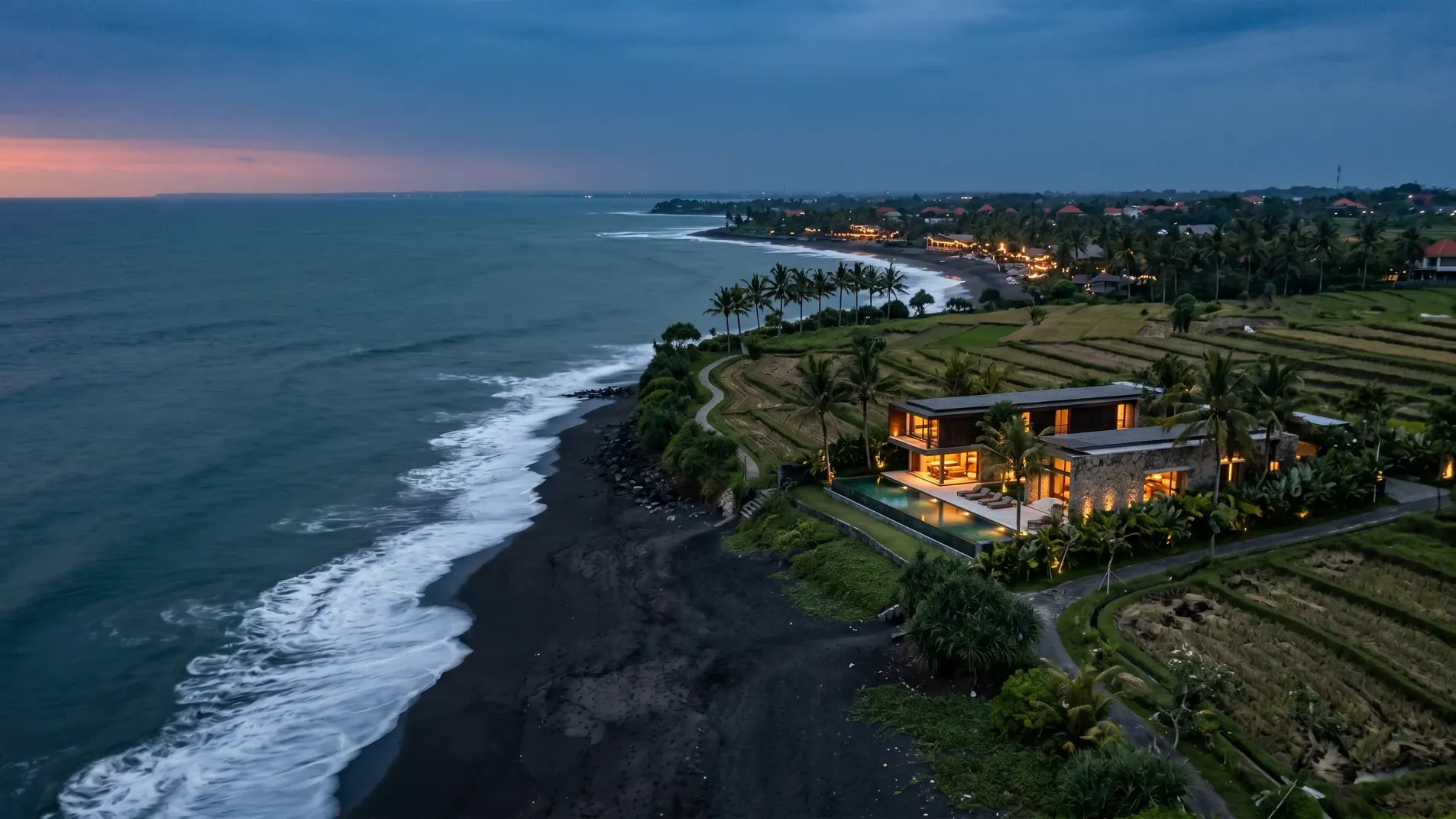
Badung · Canggu sub-corridor
Berawa, where the corridor priced in.
The matured, compliant-premium face of Canggu. Beach-club gravity and walkability sustain rate, but the entry band now sits well above Echo Beach. We read which side of the premium a Berawa villa earns.
Informational material · Not a sales call · Editorial reply, not a broker pitch
Entry band
$380k–$720k
single villa, 200–320 m² built
Price / m²
$1,900–$3,000
built area, 2026 desk reads
Gross yield
8–12%
before fees, occupancy 70–82%
Net yield (est.)
5–8%
after manager + utilities + tax
ADR range
$260–$420
peak vs shoulder spread
Risk profile
Medium-low · premium tier, beach-club concentration
Source-tier breakdown: BPS · BKPM · platform statements · editorial diligence. Methodology → · Cited by →
Informational material · Not a sales call · Editorial reply, not a broker pitch
The qualifier
Whether Berawa is your corridor.
For investors who
Berawa rewards
- buy on a 5–10-year hold and want a corridor where compliant-premium pricing is the floor, not the ceiling
- underwrite to 75% occupancy and accept that ADR rather than yield is the operative variable
- value walkability to the beach-club and cafe density that defines Berawa over a 10% yield delta further out
- treat the compliant tier's 10–15% rate premium as a thesis confirmed, not a question
Not for investors who
Berawa punishes
- are buying for maximum gross yield — the inland edge or Echo Beach prices that better
- want to flip in 12–24 months — Berawa premiums limit the velocity play
- are uncomfortable with the concentration of supply within a one-kilometre radius of Pantai Berawa
- underwrite the corridor without verifying the specific sub-zone — Pantai Berawa K3 reads differently from Tibubeneng K1 edges
The micro-map
Sub-corridors of Berawa.
The corridor name hides sub-markets that diverge on price, supply quality, and risk character.
Beach-club core
Pantai Berawa
The Finn's and Atlas corridor that defines the area's brand. Walkability and gravity sustain ADR, and the title set here clusters in K3 zoning more reliably than the inland edges.
Residential premium
Mid-Berawa
Inland from Pantai Berawa toward Jalan Berawa, where the cafe and gym density takes over. Quieter at night, the strongest long-stay segment in the corridor.
Frontier within Berawa
Tibubeneng edge
The northern edge that fades into Tibubeneng and rice-field interior. Discount pricing, the highest K1/K3 zoning ambiguity, and the corridor's lightest licensing exposure when the zoning resolves favourably.
Quiet pricing-power
Munggu border
Where Berawa transitions into Munggu — lower density, longer-stay clientele, and a quieter rate but the smallest exposure to the 2025 enforcement wave.
Recent comparables
What actually transacted.
Anonymised signed comps the desk read this quarter. The structure is the point: tenure, size, and the note the brochure omits.
| Quarter | Sub-corridor | Size built / land | Tenure | Price | $/m² | Editorial note |
|---|---|---|---|---|---|---|
| Q2 2026 | Pantai Berawa | 240 / 420 m² | Leasehold 26 yr · extension clause | $612k | $2,550 | Compliant PBG; clean reconciled 2025 platform set |
| Q2 2026 | Mid-Berawa | 200 / 340 m² | Leasehold 24 yr | $485k | $2,425 | Long-stay tenanted; 9% gross actual |
| Q1 2026 | Pantai Berawa | 310 / 460 m² | Hak Milik via PMA–HGB | $895k | $2,887 | Branded-manager leaseback; year-1 guaranteed |
| Q1 2026 | Tibubeneng edge | 190 / 310 m² | Leasehold 23 yr | $390k | $2,053 | K1 ambiguity disclosed; sold below ask |
| Q4 2025 | Mid-Berawa | 260 / 400 m² | Leasehold 28 yr · extension clause | $575k | $2,212 | Repriced after slow shoulder season |
| Q4 2025 | Munggu border | 220 / 380 m² | Leasehold 30 yr | $430k | $1,955 | Long-stay portfolio; vendor financing portion |
- Size
- 240 / 420 m²
- Tenure
- Leasehold 26 yr · extension clause
- $/m²
- $2,550
Compliant PBG; clean reconciled 2025 platform set
- Size
- 200 / 340 m²
- Tenure
- Leasehold 24 yr
- $/m²
- $2,425
Long-stay tenanted; 9% gross actual
- Size
- 310 / 460 m²
- Tenure
- Hak Milik via PMA–HGB
- $/m²
- $2,887
Branded-manager leaseback; year-1 guaranteed
- Size
- 190 / 310 m²
- Tenure
- Leasehold 23 yr
- $/m²
- $2,053
K1 ambiguity disclosed; sold below ask
- Size
- 260 / 400 m²
- Tenure
- Leasehold 28 yr · extension clause
- $/m²
- $2,212
Repriced after slow shoulder season
- Size
- 220 / 380 m²
- Tenure
- Leasehold 30 yr
- $/m²
- $1,955
Long-stay portfolio; vendor financing portion
6 of 19 transactions the desk read this quarter in this sub-corridor. The Berawa premium reads against the broader Canggu corridor frame.
The licensing read
Regulatory landscape
Berawa zoning concentrates in K2 and K3 sub-zones inside the Pantai Berawa core and mid-Berawa belt, which permit short-term rental under Pondok Wisata licensing. The Tibubeneng northern edge and certain Munggu-border lots cross into K1 (residential-only) — the desk verifies sub-zone before yield on every Berawa listing.
Licensing path through the regency permit office tracks Canggu — 6–9 months typical time-to-permit, longer if the property triggers coastal-setback review. Inventory that already holds a PBG and an operating licence repricies upward; that wait is now a quantifiable line item in the buyer's underwriting.
Tenure mix in foreign-relevant Berawa inventory leans more toward leasehold than Canggu overall — roughly 70% leasehold (25–30 year terms), 25% via PMA–HGB structures, 5% direct freehold. The PMA route is more common at the >$700k tier where the buyer plans multi-villa operation.
Recent direction: enforcement in the 2025 wave hit Berawa less hard than Echo Beach and Tibubeneng edges, because the K3 concentration in Pantai Berawa is structurally compliant. The buyer who reads the sub-zone correctly gets a corridor where licensing risk is meaningfully lower than the Canggu average. See the safest-area framework for how the desk weights this.
Boots on the ground
Operational reality
Property management mandates in Berawa run 17–22% of revenue for the established operators with reconciliation discipline, slightly tighter than the Canggu-wide range because the operator pool is mature. The desk's reconciliation work routinely finds that the cheaper Berawa mandates exclude pool chemistry and garden — the same line-item gap that quietly moves net yield by two to three points island-wide.
Seasonality is moderate. Peak runs June–August and December–early-January; the shoulder is shorter than Canggu's because the beach-club calendar sustains the corridor through September and into early November. February remains the unforgiving month.
Channel mix skews to Airbnb (~55%) and Booking.com (~30%) for the villa tier, with a more developed direct-booking infrastructure than wider Canggu — most managed Berawa villas now run 30%+ direct share by year two.
Infrastructure: mains water is reliable across the Pantai Berawa core; the Tibubeneng edge and Munggu border rely more on supplementary tanks. Power is stable. The binding constraint in Berawa is traffic to the beach club zone at peak — which both validates the corridor's pricing and caps the practical reach of an on-site manager.
The truth the brochure leaves out
3 risks we underwrite around.
Premium tier compression
Berawa's compliant-premium pricing has set the floor for the corridor's 2026 yield range. If the wider Canggu compliant tier closes the gap by year-end — and the desk's transaction read suggests it might — Berawa's ADR premium narrows, not the entry band.
Why we still publish on Berawa: the 2027 supply pipeline outside Berawa is the lowest in five years, so even compressed premium pricing holds.
Beach-club concentration
A meaningful share of Berawa's ADR thesis rests on three beach-club anchors within walking distance. Any operational disruption to the anchor cluster — licensing, management change, or a regulatory shift in evening-hours operation — would re-price the corridor faster than supply changes would.
Why we still publish on Berawa: the anchor operators have stable long-form leases and the desk reads regulatory direction quarterly via the regency cycle.
Coastal-setback enforcement
Provincial attention to coastline setback enforcement focused on the Berawa stretch in 2025. Lots within the setback line are unbuildable for new STR product — and reselling an existing structure on a setback-flagged lot is materially harder.
Why we still publish on Berawa: the setback line is verifiable before purchase; the desk reads the lot survey against the regulation before any Berawa read.
Editorial offer · BERAWA
Send a specific Berawa listing. The desk will read it.
We read the certificate before the brochure, reconcile twelve months of platform data, and return a written editorial note within forty-eight hours. No follow-up sequence. No mailing list. No broker handoff unless you ask for one.
Editorial review. No charge. Not a sales call. We disclose any referral relationship on the article body, never inside the dossier.
Read it against its neighbours
Where Berawa sits in the field.
Questions the desk gets
Berawa, asked directly.
Is resort-style property investment in Berawa worth it?
Berawa is Bali's closest thing to a resort-anchored corridor without a masterplan: beach clubs (Finns, Atlas) function as the demand engine the way ITDC hotels do for Nusa Dua, and branded or resort-style residences trade on that anchor. The investment read: resort-adjacent product earns the corridor's top ADR band and the strongest shoulder-season occupancy, but you pay a 15–25% entry premium over standalone villas and carry HOA-style service charges that compress net yield by 1–2 points. It fits investors who prioritize occupancy stability over maximum yield; pure yield-maximizers do better with a standalone licensed villa two streets inland.
How much does a villa in Berawa cost in 2026?
Berawa villa prices in 2026 typically range from USD 400000 for entry-tier 1-2 bedroom leasehold villas to USD 2,000,000+ for premium properties. Mid-tier transactions cluster around USD 900000. The $/m² range is USD 4,000-6,500 depending on lot position, build quality, and remaining lease term.
What rental yield does Berawa property generate?
Berawa managed STR product typically delivers 8-12 percent gross rental yield and 5-8 percent net after OTA commission (15-20 percent), property manager fee (15-22 percent of net revenue), PPh Final 10 percent withholding, CapEx reserve (8-10 percent of gross), insurance, and operating costs. Net yield assumes professional management and 60-75 percent occupancy.
Is Berawa a good area to buy property?
Berawa fits a specific buyer profile, not every buyer. Capital-appreciation-oriented buyers willing to pay a premium for proven STR rental product. Brand-conscious owners who want the beach club + lifestyle stack baked in. It is not the right corridor for buyers expecting the exact economics of Canggu core or for buyers prioritising the highest possible STR yield. Read the Canggu guide alongside this page for the structural framing.
What are the main risks of buying in Berawa?
Yield has compressed roughly 200 basis points versus the 2020-2022 peak as supply caught up to demand. Premium positioning is sensitive to bench-marking against Uluwatu and emerging Phuket competitive sets. Beach erosion at sections of the Berawa coast has been the topic of provincial regulatory attention. Always run the seven-point pre-deposit checklist on the diligence page before any deposit, regardless of corridor.
Should I buy in Berawa or Canggu?
Buy in Berawa if the discount versus Canggu (typically 10-30 percent on equivalent product) outweighs the differences in operator depth, resale liquidity, and corridor maturity. Buy in Canggu if you want the most liquid, most operator-rich exit. The decision is a function of holding horizon and risk appetite, not a binary right answer.
The editorial trail
Related reading
This area read is updated quarterly. Last review: 13 June 2026. Next scheduled review: 13 September 2026. Material new licensing rulings or transaction-data shifts trigger interim updates. How we update articles →