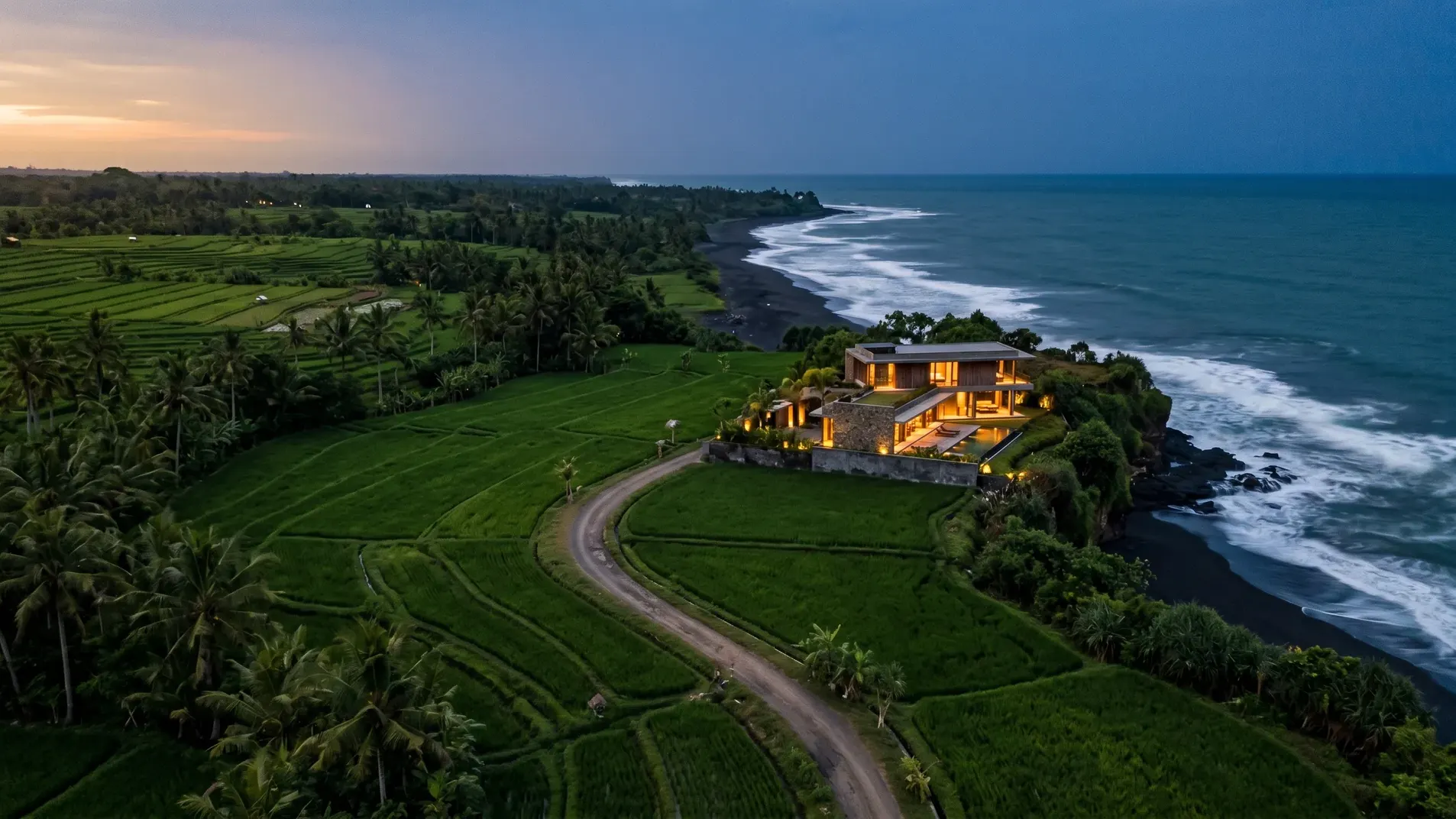
Badung · Frontier north of Pererenan
Cemagi, the appreciation play.
The quieter frontier above Pererenan, where the land-to-built ratio still favours the patient buyer. Yields lag, but the appreciation thesis sits closer to the corridor's edge than to its centre.
Informational material · Not a sales call · Editorial reply, not a broker pitch
Entry band
$210k–$520k
single villa, 180–320 m² built
Price / m²
$1,150–$2,100
built area, 2026 desk reads
Gross yield
6–9%
before fees, occupancy 55–72%
Net yield (est.)
3.5–6%
after manager + utilities + tax
ADR range
$180–$280
peak vs shoulder, thinner peak premium
Risk profile
Medium-high · early-cycle, title-conversion exposure
Source-tier breakdown: BPS · BKPM · platform statements · editorial diligence. Methodology → · Cited by →
Informational material · Not a sales call · Editorial reply, not a broker pitch
The qualifier
Whether Cemagi is your corridor.
For investors who
Cemagi rewards
- hold 5+ years and underwrite to appreciation rather than near-term net yield
- are willing to bring an operator or accept a thinner local manager pool
- value black-sand beach proximity at an entry band the Canggu core does not offer
- verify the Letter C to SHM title-conversion path on every Cemagi lot before deposit
Not for investors who
Cemagi punishes
- need cashflow from year one — Cemagi's yield range cannot support that thesis
- want operator depth — the manager pool is thin and turnover is real
- are uncomfortable with PBG timelines that run 9–14 months in this regency edge
- underwrite the corridor without the title-history work — Cemagi rewards the title-clean buyer and punishes the rushed one
The micro-map
Sub-corridors of Cemagi.
The corridor name hides sub-markets that diverge on price, supply quality, and risk character.
Frontier premium
Cemagi beachfront
The narrow strip with black-sand-beach access where pricing already prices in the appreciation thesis. The lowest yield within Cemagi, the highest expected price growth.
Discount supply
Cemagi interior
Inland paddies and rural lanes. The price band the desk reads most often — entry-tier 2-bed villas with verified title sit here.
Quietest hold
Seseh edge
The transition to Seseh — quieter again, longer-stay clientele, and the area where the desk has seen the cleanest tenure-history files.
Off-Badung edge
Tabanan border
The lots that cross into Tabanan regency. Different regency permit cycle, different signage rules, longer paths to a finalised PBG — but the entry band drops materially.
Recent comparables
What actually transacted.
Anonymised signed comps the desk read this quarter. The structure is the point: tenure, size, and the note the brochure omits.
| Quarter | Sub-corridor | Size built / land | Tenure | Price | $/m² | Editorial note |
|---|---|---|---|---|---|---|
| Q2 2026 | Cemagi beachfront | 210 / 380 m² | Leasehold 27 yr | $485k | $2,309 | Compliant PBG; ocean view, narrow rear lot |
| Q2 2026 | Cemagi interior | 180 / 340 m² | Leasehold 25 yr | $295k | $1,638 | Title converted Letter C → SHM at year minus 1 |
| Q1 2026 | Seseh edge | 200 / 420 m² | Leasehold 30 yr · extension clause | $315k | $1,575 | Long-stay portfolio; PBG pending at sale |
| Q1 2026 | Tabanan border | 190 / 360 m² | Leasehold 28 yr | $258k | $1,357 | Tabanan-side; different licensing path disclosed |
| Q4 2025 | Cemagi interior | 240 / 400 m² | Hak Milik via PMA–HGB | $435k | $1,812 | Multi-villa portfolio play; clean structure |
| Q4 2025 | Cemagi beachfront | 230 / 320 m² | Leasehold 24 yr | $415k | $1,804 | Short lease repriced 12% before sale |
- Size
- 210 / 380 m²
- Tenure
- Leasehold 27 yr
- $/m²
- $2,309
Compliant PBG; ocean view, narrow rear lot
- Size
- 180 / 340 m²
- Tenure
- Leasehold 25 yr
- $/m²
- $1,638
Title converted Letter C → SHM at year minus 1
- Size
- 200 / 420 m²
- Tenure
- Leasehold 30 yr · extension clause
- $/m²
- $1,575
Long-stay portfolio; PBG pending at sale
- Size
- 190 / 360 m²
- Tenure
- Leasehold 28 yr
- $/m²
- $1,357
Tabanan-side; different licensing path disclosed
- Size
- 240 / 400 m²
- Tenure
- Hak Milik via PMA–HGB
- $/m²
- $1,812
Multi-villa portfolio play; clean structure
- Size
- 230 / 320 m²
- Tenure
- Leasehold 24 yr
- $/m²
- $1,804
Short lease repriced 12% before sale
6 of 14 transactions the desk read this quarter in this sub-corridor. The Cemagi frontier reads against the broader Canggu corridor frame and the Pererenan inland edge.
The licensing read
Regulatory landscape
Cemagi zoning sits across two regencies — Badung for most of the corridor and a strip that crosses into Tabanan. RTRW zoning on the Badung side mirrors Canggu's K1/K2/K3 framework; the Tabanan border lots follow the Tabanan regency permit cycle, which is slower and produces a different licensing document set. The desk verifies which regency a Cemagi lot sits in before any yield read.
Title-conversion (Letter C / Petok D into a Sertifikat Hak Milik) is the routine pre-purchase step that defines Cemagi. Many of the lower-priced lots trade on tenure that has not yet been formalised through the BPN, and the conversion path is what closes — or kills — the deal. Estimate 4–9 months for title-conversion, and price the carrying cost into the underwrite.
Licensing path through Pondok Wisata applies on the Badung side; the Tabanan border lots follow a different but parallel path. The PBG backlog runs 9–14 months at the Cemagi end of Badung — longer than central Canggu — because the regency office volume is higher and the lots are further from the inspection cluster.
Recent direction: 2025 enforcement attention concentrated on the Badung beach corridor (Canggu and Berawa); Cemagi saw lighter enforcement because the operator density is lower. For the forward-cycle buyer the framework is in the PMA vs leasehold decision and the safest-area framework. Cemagi rewards the buyer who treats title work as part of the underwrite, not an afterthought.
Boots on the ground
Operational reality
Property management mandates in Cemagi run 20–28% of revenue — wider than the Canggu range because the operator pool is genuinely thin. The desk has seen well-run Cemagi mandates at 18% and badly-run ones at 30%; the spread tracks operator depth, not corridor reality.
Seasonality is more severe than the Canggu core because the brand pull is weaker. July–August and the December–January peak still work, but the shoulder is longer and the floor lower. Underwriting to 65% blended occupancy is realistic; the 80% sponsor decks the desk has seen for Cemagi do not survive a reconciled twelve-month read.
Channel mix in Cemagi is more Airbnb-dependent than the broader Canggu corridor; Booking.com share is thinner because the inventory is smaller and the brand presence is younger. Direct-booking share rarely exceeds 20% in the first two years of a Cemagi villa's operation.
Infrastructure: mains water reaches Cemagi but pressure is variable; supplementary tank capacity is more important here than in central Canggu. Power is stable but outage frequency is higher. Road access from the Canggu beach corridor adds 12–18 minutes — a meaningful number when the on-site manager covers more than one villa.
The truth the brochure leaves out
3 risks we underwrite around.
Title conversion exposure
A material share of Cemagi inventory trades on tenure that has not yet been formalised through the BPN. The Letter C / Petok D conversion path is routine but it is also where deals fall apart. A Cemagi lot with unclear title history is a different asset from a Cemagi lot with a clean SHM, even at the same listing price.
Why we still publish on Cemagi: the desk's diligence stack reads title-history first. A title-clean Cemagi lot is a better risk-adjusted return than a title-questionable Canggu one.
Operator thinness
There are at most a handful of property managers operating at scale in Cemagi today. The thin pool means switching costs are high and a bad manager is expensive to replace. The villa that gets the right manager outperforms the villa next door that did not.
Why we still publish on Cemagi: the corridor is on a clear maturation arc — the desk sees new operators committing to Cemagi every quarter.
Tabanan-side regulatory drift
Lots that cross into Tabanan regency follow a different signage, licensing, and tax-collection cadence. A Cemagi listing that does not disclose the regency boundary is a listing with a flaw the brochure rarely surfaces.
Why we still publish on Cemagi: the desk reads the regency boundary on every Cemagi listing and flags Tabanan-side lots in writing before yield.
Editorial offer · CEMAGI
Send a specific Cemagi listing. The desk will read it.
We read the certificate before the brochure, reconcile twelve months of platform data, and return a written editorial note within forty-eight hours. No follow-up sequence. No mailing list. No broker handoff unless you ask for one.
Editorial review. No charge. Not a sales call. We disclose any referral relationship on the article body, never inside the dossier.
Read it against its neighbours
Where Cemagi sits in the field.
Questions the desk gets
Cemagi, asked directly.
How much does a villa in Cemagi cost in 2026?
Cemagi villa prices in 2026 typically range from USD 200000 for entry-tier 1-2 bedroom leasehold villas to USD 700000+ for premium properties. Mid-tier transactions cluster around USD 380000. The $/m² range is USD 1,500-2,800 depending on lot position, build quality, and remaining lease term.
What rental yield does Cemagi property generate?
Cemagi managed STR product typically delivers 8-11 percent gross rental yield and 5-8 percent net after OTA commission (15-20 percent), property manager fee (15-22 percent of net revenue), PPh Final 10 percent withholding, CapEx reserve (8-10 percent of gross), insurance, and operating costs. Net yield assumes professional management and 60-75 percent occupancy.
Is Cemagi a good area to buy property?
Cemagi fits a specific buyer profile, not every buyer. Forward-cycle investors betting on 3-5 year corridor maturation. Lifestyle buyers who want black-sand beaches and rice paddies on a smaller budget than Pererenan. It is not the right corridor for buyers expecting the exact economics of Tabanan border core or for buyers prioritising the highest possible STR yield. Read the Tabanan border guide alongside this page for the structural framing.
What are the main risks of buying in Cemagi?
Title conversion (Letter C to SHM) is a routine pre-purchase step here. PBG issuance timelines run longer than Badung-side equivalents. STR operator depth is thin; expect to either bring your own manager or accept a learning curve. Always run the seven-point pre-deposit checklist on the diligence page before any deposit, regardless of corridor.
Should I buy in Cemagi or Tabanan border?
Buy in Cemagi if the discount versus Tabanan border (typically 10-30 percent on equivalent product) outweighs the differences in operator depth, resale liquidity, and corridor maturity. Buy in Tabanan border if you want the most liquid, most operator-rich exit. The decision is a function of holding horizon and risk appetite, not a binary right answer.
The editorial trail
Related reading
This area read is updated quarterly. Last review: 13 June 2026. Next scheduled review: 13 September 2026. Material new licensing rulings or transaction-data shifts trigger interim updates. How we update articles →