Decide
Pondok Wisata Licensing 2026: Bali Villa Short-Term Rental Licence Complete Guide
Complete 2026 guide to Pondok Wisata licensing for foreign-owned Bali villas: who needs it post-2025 enforcement, document requirements, application timeline, cost ($800-$3000), regency-specific quirks, renewal cycle, and the 8 ways the licence gets revoked. Editorial reference for STR investors.
Quick facts
- 01Pondok Wisata is the Indonesian tourism business licence required for commercial short-term rental of a Bali villa. Foreign-held property must apply via PT PMA structure; personal Hak Sewa cannot hold Pondok Wisata directly.
- 02Post-2025 enforcement: 48 illegal villas, homestays and tourism facilities were demolished at Bingin Beach (Badung Regency) on 2025-07-21 under personal supervision of Bali Governor I Wayan Koster and Badung Regent I Wayan Adi Arnawa. Civil service police continue sealing unlicensed villas across Canggu, Uluwatu and Ubud. Permanent OTA blocking of ~1,600 unlicensed accommodations begins 2026-08-01 (the original 2026-03-31 deadline was rolled by the Ministry of Tourism). Licensing is no longer optional for commercial-scale rental.
- 03Application timeline: 5 to 8 months from PT PMA setup to Pondok Wisata licence in hand. Plan well ahead of expected operating start.
- 04Total cost: $800 to $3,000 in regency fees + facilitator costs (not counting the PT PMA setup which is $4,000 to $8,000). Renewal every 5 years.
Key Takeaways
- Pondok Wisata is the Indonesian tourism business licence required for commercial short-term rental of a Bali villa. Foreign-held property must apply via PT PMA structure; personal Hak Sewa cannot hold Pondok Wisata directly.
- Post-2025 enforcement: 48 illegal villas, homestays and tourism facilities were demolished at Bingin Beach (Badung Regency) on 2025-07-21 under personal supervision of Bali Governor I Wayan Koster and Badung Regent I Wayan Adi Arnawa. Civil service police continue sealing unlicensed villas across Canggu, Uluwatu and Ubud. Permanent OTA blocking of ~1,600 unlicensed accommodations begins 2026-08-01 (the original 2026-03-31 deadline was rolled by the Ministry of Tourism). Licensing is no longer optional for commercial-scale rental.
- Application timeline: 5 to 8 months from PT PMA setup to Pondok Wisata licence in hand. Plan well ahead of expected operating start.
- Total cost: $800 to $3,000 in regency fees + facilitator costs (not counting the PT PMA setup which is $4,000 to $8,000). Renewal every 5 years.
- Required documents: PT PMA OSS-RBA registration with KBLI 55130, HGB certificate in PT PMA name, valid IMB or PBG building permit, RTRW tourism zone confirmation, fire and safety certificate, and UKL-UPL environmental document. Single-villa operations qualify — Pondok Wisata is the small-scale tourism accommodation category, not a multi-unit threshold.
- Eight ways the licence gets revoked: zone violations, unpaid PBB, missing fire certificate, expired IMB, illegal building modifications, neighbour complaints, violation of guest-record reporting, and failure to remit tourism levy.
Key takeaways
- Pondok Wisata is the Indonesian tourism business licence required for commercial Bali villa STR rental
- Foreign-held property must apply via PT PMA structure; personal Hak Sewa cannot hold licence directly
- Post-2025 enforcement: 48 villas demolished at Bingin Beach 2025-07-21; ongoing civil-service-police sealing across Canggu/Uluwatu/Ubud; permanent OTA blocking of unlicensed listings begins 2026-08-01
- Application timeline: 5 to 8 months from PT PMA setup to licence in hand
- Total cost: $800 to $3,000 regency fees + $2,000 to $4,000 facilitator costs (PT PMA setup separate)
- Renewal every 5 years; revocation triggers include zone violations, unpaid PBB, expired IMB, neighbour complaints
This is the Bali Villa Select editorial desk's framework for navigating Pondok Wisata licensing — the regulatory layer that 2025 enforcement made non-negotiable for any foreign-owned villa with commercial STR intent, and that most foreign buyers underweight at purchase because the broker rarely mentions it.
The pattern: a foreign investor purchases a Canggu villa, gets the AJB Hak Sewa signed, contracts an operator, and starts listing on Airbnb under the operator's "umbrella" licence. Six to twelve months later, regency tourism enforcement visits, finds the property listing on OTA platforms without proper Pondok Wisata licence on file in the buyer's structure, and issues a cease-and-desist order. Bookings are paused, deposits refunded, and operating revenue collapses while the buyer scrambles to either licence retroactively (more expensive) or sell.
The 2025 enforcement wave fundamentally changed the calculus. Pondok Wisata licensing is no longer a "next year" item. It is an operational precondition.
What changed in 2025 — the licensing enforcement reset
The 2025 enforcement wave was driven by three structural pressures.
First: the post-COVID tourism recovery brought operating density back to or above pre-2020 levels in Canggu, Pererenan, and Berawa. Local residents increasingly raised complaints about unlicensed STR operating in residential-zoned villas.
Second: the Bali provincial government's tourism levy revenue depended on registered accommodation declarations. Unlicensed STR represented a quantifiable revenue gap.
Third: the Ministry of Tourism issued guidance prioritising enforcement in mature tourism corridors. Badung Regency tourism office (Dinas Pariwisata Badung) operationalised this guidance through Q2 2025 inspection campaigns.
Documented outcomes 2025:
- 48 illegal villas, homestays and tourism facilities demolished at Bingin Beach (Uluwatu) on 2025-07-21 under direct supervision of Bali Governor I Wayan Koster and Badung Regent I Wayan Adi Arnawa. The structures had been built without permits on land owned by Badung Regency Government.
- Civil-service police (Satpol PP) ongoing villa-sealing ("disegel" notices) across Canggu, Pererenan, Berawa, Uluwatu and Ubud throughout Q3 and Q4 2025. Sealed properties cannot operate until proper licensing is obtained.
- OTA platform blocking from 2026-08-01 (schedule updated 2026-07-03): all Indonesian short-term-rental listings must hold an NIB + correct accommodation KBLI per UU 18/2025 enforcement guidance. The original 2026-03-31 deadline was rolled by the Ministry of Tourism — NIB/KBLI submission ran to end of June 2026, a grace period runs through July 31, and permanent simultaneous blocking of ~1,600 unlicensed accommodations across Airbnb, Booking.com, Agoda, Traveloka and Tiket.com begins 2026-08-01. Dated timeline: Licensing Enforcement Tracker.
- Fines and penalties: unlicensed operation penalties start at IDR 50 million ($3,300). Foreign individuals operating without proper permits face deportation and a 1-6 year blacklist from Indonesia.
- Owner liability extended to foreign investors operating via Hak Sewa-only structures — historically the operator carried the licensing risk, but 2025 enforcement clarified the principal owner is also exposed.
- Editorial estimate: broader cease-and-desist activity beyond the documented Bingin demolitions affects several hundred properties across the Canggu/Pererenan/Berawa/Uluwatu/Ubud belt; precise totals are not published by Dinas Pariwisata. We treat the 48-property Bingin event as the documented anchor and the broader wave as editorial inference from operator interviews and Satpol PP press releases.
For 2026 investors, the enforcement reset means: assume licensing is mandatory from day one. Retrospective compliance is materially more expensive than upfront setup, and the August 1, 2026 platform blocking forecloses the "stay off the radar" option. What that blocking does to the asset itself — broker-reported 15 to 25 percent discounts on non-compliant stock and guaranteed-yield contracts left resting on the guarantor's balance sheet — is analysed in our delisting value-impact read.
Who must hold Pondok Wisata licence
The Pondok Wisata licence holder must be an Indonesian legal entity or Indonesian individual. The three structural options for foreign-held property:
Option 1: PT PMA holds the property AND the licence (cleanest)
The foreign-owned PT PMA holds HGB land rights to the property AND applies for Pondok Wisata licence in PT PMA name. The PT PMA structure is engineered specifically for this combined role.
Pros: cleanest legal structure, licence holder controls property, optimal for multi-villa portfolios.
Cons: PT PMA setup cost $4,000 to $8,000 plus annual compliance $2,000 to $4,000.
Best fit: investors with $500,000+ property exposure or multi-property intent.
Option 2: Personal Hak Sewa + operator's umbrella licence (workaround)
Foreign individual holds Hak Sewa leasehold. Engages a Bali villa operator that holds its own Pondok Wisata licence covering multiple properties under management. The operator's licence covers the property's STR operation while it is under management.
Pros: no PT PMA setup cost, simpler personal-tax treatment of rental income.
Cons: licensing legal liability stays with operator (creates exit complexity), operator change requires re-licensing or licence transfer, operator quality risk amplifies, limited control over licensing compliance.
Best fit: single-villa investors under $500,000 with strong operator relationship.
Option 3: Personal Hak Sewa + own Indonesian-resident representative
Foreign individual holds Hak Sewa. Engages an Indonesian resident (employee, family of trusted local partner, or formal manager) to apply for Pondok Wisata in their personal name on behalf of the owner.
Pros: lower formal cost than PT PMA.
Cons: licence is in the Indonesian representative's name, creating dependency and legal-liability mismatch. The representative can theoretically pull the licence on exit or in disputes. The 2025 enforcement guidance treated nominee-style arrangements with elevated scrutiny. Materially less defensible than Option 1.
Best fit: rare; only for short-hold transitional cases.
The 12-step Pondok Wisata application path
Phase 1: PT PMA setup (months 1 to 2 if not already established)
Step 1: PT PMA OSS-RBA registration with KBLI 55130
Register PT PMA on OSS-RBA platform with KBLI business code 55130 (Pondok Wisata). This code specifically authorises tourism accommodation business at the Pondok Wisata category.
Documents required: company articles, shareholder identification, paid-up capital evidence (10 billion rupiah minimum for PT PMA), commissioner and director identification.
Timeline: 4 to 6 weeks for OSS registration and NIB (Nomor Induk Berusaha) business identification number issuance.
Cost: $1,500 to $3,000 in OSS registration + facilitator fees.
Step 2: HGB land rights transfer to PT PMA
Transfer the property's land rights to the PT PMA via HGB (Hak Guna Bangunan — right to build, 30 + 20 + 30 years effective). This requires AJB transfer and BPN registration.
Documents required: existing SHM/HGB certificate, PT PMA OSS, identity documents, BPHTB tax payment.
Timeline: 4 to 6 weeks for AJB + BPN registration completion.
Cost: BPHTB 5 percent of property value + notaris fees + BPN registration. On a $500k villa, approximately $30,000 to $40,000 total.
Phase 2: Building documentation verification (months 2 to 4)
Step 3: IMB or PBG building permit verification
The property must have valid IMB Izin Mendirikan Bangunan or the post-2022 equivalent PBG Persetujuan Bangunan Gedung. The IMB/PBG must match the actual built structure (no unpermitted additions).
Documents required: original IMB or PBG, current architectural drawings showing as-built condition, regency planning office certification.
Timeline: 2 to 4 weeks if existing IMB is valid; 3 to 6 months if IMB needs amendment or new application.
Cost: $200 to $1,500 for verification; $5,000 to $20,000+ if building amendment required.
Step 4: RTRW tourism zone confirmation
The property must be located in Pariwisata tourism zone per the regency RTRW (Rencana Tata Ruang Wilayah) land use plan.
Documents required: official RTRW zoning letter from regency planning office (Dinas Pekerjaan Umum dan Penataan Ruang).
Timeline: 1 to 2 weeks.
Cost: $50 to $200.
Critical: if the property is in residential zone (Perumahan) not tourism zone, Pondok Wisata cannot be issued. Some buyers discover this gap at this step. Verify zoning BEFORE purchasing, ideally during the PPJB conditions precedent phase.
Step 5: Fire and safety certificate
Regency fire department issues a Sertifikat Laik Fungsi (SLF) or fire safety certificate confirming the property meets fire safety standards (smoke detectors, fire extinguishers, emergency exits, evacuation plan).
Timeline: 3 to 6 weeks for inspection and certification.
Cost: $130 to $330 in regency fees + $200 to $500 in safety equipment if upgrades required.
Step 6: UKL-UPL environmental management document
Smaller-scale accommodation requires UKL-UPL (Upaya Pengelolaan Lingkungan dan Upaya Pemantauan Lingkungan) — environmental management and monitoring documents approved by regency environment office.
Documents required: water sourcing plan, waste management plan, sewage treatment plan, neighbour impact assessment.
Timeline: 4 to 8 weeks for document preparation and approval.
Cost: $330 to $670 in formal fees + $500 to $1,500 in environmental consultant fees.
Phase 3: Pondok Wisata application (months 4 to 6)
Step 7: Compile Pondok Wisata application file
Required documents:
- PT PMA OSS-RBA registration with KBLI 55130
- HGB certificate in PT PMA name
- Valid IMB or PBG building permit
- RTRW tourism zone confirmation
- Fire and safety certificate
- UKL-UPL environmental document
- Building floor plan + room inventory
- PT PMA NPWP tax ID
- Company directors and commissioners identification
- Bank account statement
- PBB tax receipts (last 3 years)
- Written tourism business plan
Step 8: Submit application via OSS-RBA + regency tourism office
The application is filed through OSS-RBA online portal AND parallel paper submission to Dinas Pariwisata regency tourism office. Both are required.
Timeline: 1 to 2 weeks for submission acknowledgement.
Cost: $50 to $200 in submission fees.
Step 9: Regency tourism office inspection
The regency tourism office (Dinas Pariwisata Badung for Canggu/Uluwatu/Nusa Dua, Dinas Pariwisata Denpasar for Sanur, Dinas Pariwisata Gianyar for Ubud) conducts physical inspection.
Inspection scope: building condition vs floor plan, fire safety equipment present, guest rooms meet standards (minimum 9 m² for single, 12 m² for double), bathroom and kitchen facilities adequate, neighbour notification posted.
Timeline: 2 to 4 weeks from submission to inspection date.
Cost: facilitator costs for inspection day, approximately $200 to $500.
Step 10: Pondok Wisata licence issuance
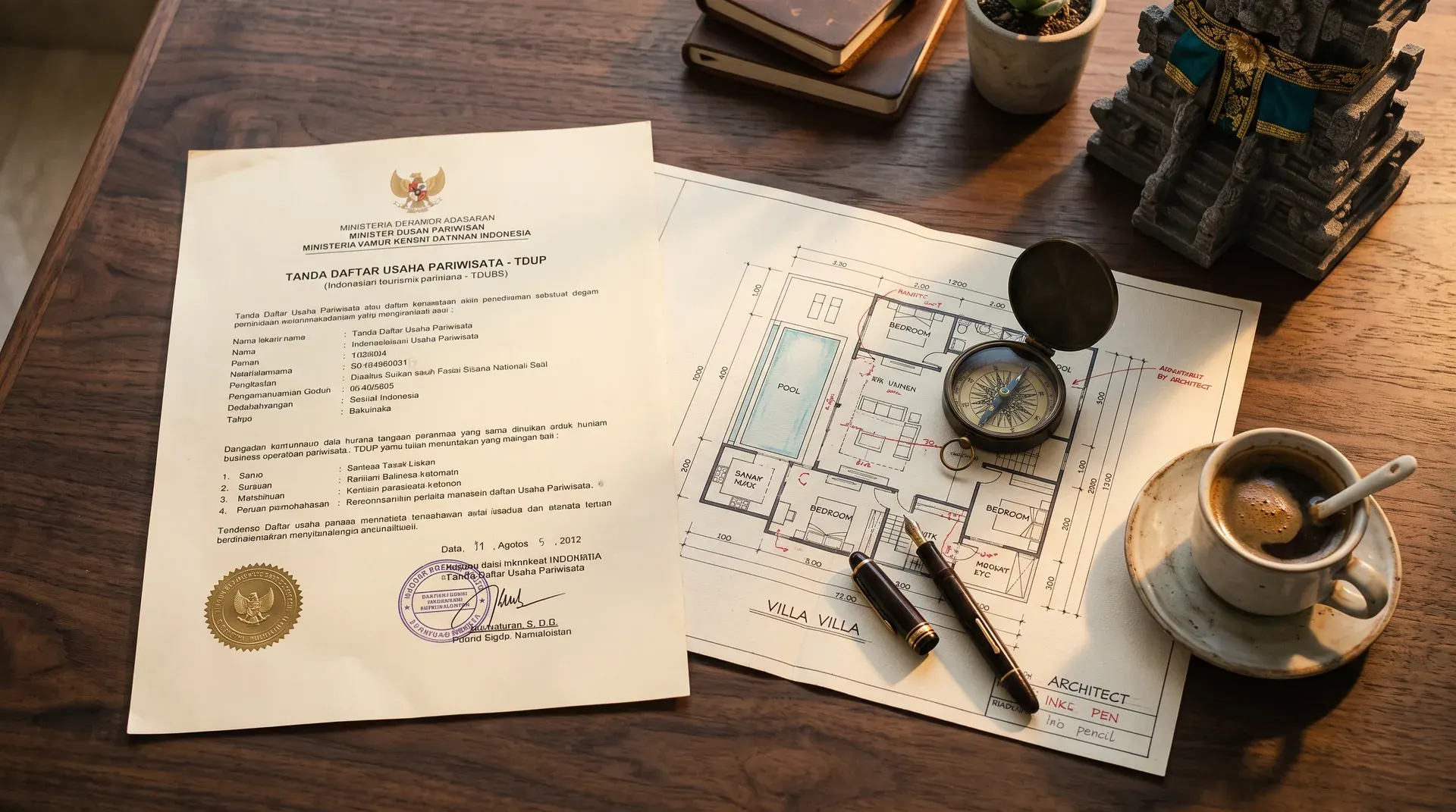
Upon successful inspection, the regency tourism office issues the Pondok Wisata licence (Tanda Daftar Usaha Pariwisata — TDUP). Licence is valid 5 years and is automatically renewable subject to ongoing compliance.
Timeline: 2 to 4 weeks after successful inspection.
Cost: $50 to $200 in licence issuance fees.
Step 11: Post-licence compliance setup
Once licensed, the property must comply with ongoing tourism business requirements:
- Monthly guest registration reporting to Dinas Pariwisata (number of guests, nationalities, duration)
- Quarterly tourism levy remittance (10,000 rupiah per guest-night)
- Annual licence renewal verification
- PBB annual tax payment
- Fire and safety re-certification every 3 years
- UKL-UPL re-validation every 5 years
Set up an Indonesian-resident compliance representative (operator's administrative team or dedicated tourism business agent) to manage these ongoing obligations.
Step 12: Renewal cycle setup
The Pondok Wisata licence is valid 5 years. Begin renewal preparation 6 months before expiry. Documents required for renewal: continued tourism zone status, current IMB/PBG validity, fire/safety re-certification, UKL-UPL re-validation, PBB current, and licence holder identification.
Renewal cost: 50 percent of initial application cost (approximately $400 to $1,500).
Total cost breakdown — Canggu villa, $500k value, PT PMA structure
Phase 1 (PT PMA + property transfer): $5,000 PT PMA setup + $30,000 BPHTB + $5,000 notaris-PPAT + $1,000 BPN = $41,000
Phase 2 (building documentation): $1,500 IMB verification + $200 RTRW confirmation + $500 fire safety + $1,500 UKL-UPL + $500 environmental consultant = $4,200
Phase 3 (Pondok Wisata application): $200 OSS + $500 inspection facilitation + $200 licence issuance + $1,500 facilitator total = $2,400
Total one-time cost: $47,600 (9.5 percent of property value)
Annual ongoing cost: PBB $1,000 + PT PMA compliance $3,000 + tourism levy reporting + licence-stage renewals = approximately $5,000 per year.
5-year cumulative cost (one-time + 5 years annual): $72,600 (14.5 percent of property value).
For investors comparing to operator-umbrella structure (Option 2), the PT PMA + Pondok Wisata path is materially more expensive but provides direct licensing control and exit flexibility.
The 8 ways the licence gets revoked
Once issued, the Pondok Wisata licence is subject to revocation under defined triggers. Eight common revocation paths:
- Zone violations: property operates STR while regency reclassifies the zone from tourism to residential, OR property expands into adjacent non-tourism zone.
- Unpaid PBB: 12+ months of unpaid PBB land tax triggers automatic licence suspension.
- Expired IMB or PBG: building permit expires or property is modified beyond permit scope without new authorisation.
- Fire safety violations: failed re-certification or documented safety incident.
- Unpermitted building modifications: rooftop additions, illegal extensions, or modifications without IMB amendment.
- Neighbour complaints leading to mediation failure: repeated noise, parking, or capacity violations.
- Failure to submit monthly guest reports: 6+ months of missing guest registration reporting triggers automatic suspension.
- Tourism levy non-remittance: unpaid 10,000 rupiah per guest-night tourism levy for 6+ months.
Defence: assign Pondok Wisata compliance to a competent Indonesian-resident administrator. The cost of compliance is materially lower than the cost of revocation.
Common Pondok Wisata mistakes
Five mistakes the editorial desk sees most often:
- Assuming the operator's umbrella licence is sufficient long-term. Operator changes, the licence transfer or re-application becomes the foreign owner's problem.
- Skipping the RTRW zoning verification before purchase. Discovering the property is residential-zoned at Pondok Wisata application stage is a deal-killer.
- Underweighting the application timeline. A foreign buyer planning to operate 2 months after AJB is unrealistic; budget 6 to 8 months.
- Using a non-specialist facilitator. Generic local business agents rarely understand foreign-investor Pondok Wisata pathways. Use a tourism business consultant with Bali foreign-investor track record.
- Failing to set up post-licence compliance early. Missing monthly guest report submissions for the first 6 months triggers automatic suspension — easily preventable but commonly skipped.
The 12-point pre-application checklist
Before working through the paper checklist, run the villa through the 5-question interactive licence checker — it classifies any property against the four compliance checks behind the August 1 blocking (NIB, KBLI, Pondok Wisata, zoning) and returns a fixable-vs-unfixable verdict in under a minute.
Before submitting Pondok Wisata application:
- Is the PT PMA OSS registered with KBLI 55130 specifically?
- Is the HGB land rights certificate in PT PMA name (not foreign individual or nominee)?
- Is the property in tourism zone per RTRW (verified via regency planning office)?
- Is the IMB or PBG building permit valid and matching as-built condition?
- Are all PBB arrears current and receipts available?
- Is the fire and safety certificate current or under active application?
- Is the UKL-UPL environmental document approved or under regency review?
- Are building floor plans and room inventory accurate and ready for inspection?
- Has a written tourism business plan been prepared (services, pricing, operating standards)?
- Is the application facilitator vetted with foreign-investor Pondok Wisata track record?
- Has the post-licence compliance role been assigned (monthly reporting, tourism levy)?
- Is the renewal cycle (5 years) calendared into the operating plan?
Cross-references
- Biggest Bali Property Scams — including unlicensed-villa scams targeting foreign buyers
- Fake NIB & Licence-Agent Scams 2026 — verifying a real NIB/KBLI against fraudulent fast-track agents
- Canggu Property Investment Guide 2026 — corridor-specific licensing enforcement context
- Bali Property Tax Guide 2026 — ongoing tax burden including tourism levy
- AJB Hak Sewa Signing Step-by-Step — transaction-day process
- PT PMA vs Leasehold Decision Tree — structural choice impacting licensing
- Methodology — how the editorial desk sources licensing data
The editorial desk reviews Bali Pondok Wisata licensing changes quarterly. Request the dossier for a structural read on your specific property and operating plan before applying — the cost of pre-application review is materially lower than the cost of an application that fails at inspection stage.
Frequently Asked
Do I need Pondok Wisata licence to rent my Bali villa on Airbnb in 2026?
Yes for commercial-scale rental. The Indonesian tourism business framework requires any property offering short-term accommodation (less than 90 days per stay) to be registered under either Pondok Wisata, Hotel Melati, or Hotel Bintang category depending on size and service level. Individual villas typically fall under Pondok Wisata. The 2025 Bali enforcement wave specifically targeted unlicensed short-term rentals in Canggu, Pererenan, and Berawa, with cease orders issued to over 400 properties between Q2 and Q4 2025. Personal-occasional rental (under 90 days per year, single villa, no operator) sits in a gray area that 2025 enforcement has tightened but not definitively criminalised. For any commercial rental thesis, Pondok Wisata licensing is now operationally mandatory.
Can a foreign-owned villa hold Pondok Wisata licence directly?
No — Pondok Wisata licence cannot be issued to a personal foreign owner or to a Hak Sewa leasehold held in foreign individual name. The licence holder must be either an Indonesian individual (KTP holder) or an Indonesian legal entity (PT or PT PMA). Foreign investors typically structure as PT PMA Indonesian foreign-owned company, with the PT PMA holding both the property (via HGB land rights) and the Pondok Wisata licence. The PT PMA structure carries roughly $4,000 to $8,000 setup cost plus $2,000 to $4,000 annual compliance, making it material for single-villa investors but standard for multi-villa portfolios. For single-villa Hak Sewa structures, the workaround is to engage a competent local operator with their own Pondok Wisata licence covering the property under management agreement — but the licensing legal liability stays with the operator, not the foreign owner.
How long does it take to get Pondok Wisata licence in Bali 2026?
Five to eight months from initial PT PMA setup to Pondok Wisata licence in hand. Breakdown: PT PMA OSS-RBA registration (4 to 6 weeks), HGB land rights transfer to PT PMA (4 to 6 weeks), IMB/PBG building permit verification (2 to 4 weeks), fire and safety certificate (3 to 6 weeks), UKL-UPL environmental document (4 to 8 weeks), Pondok Wisata application + regency review (4 to 6 weeks). The fastest deals close in 16 weeks if PT PMA is pre-existing and building documentation is already valid. Slow deals stretch to 32 weeks if there are IMB gaps, zoning issues, or environmental documentation complications. Plan well ahead of the intended operating start date.
How much does Pondok Wisata licensing cost in Bali 2026?
Direct regency fees: 800,000 to 3,000,000 rupiah ($55 to $200) for the Pondok Wisata application itself. Supporting documents: IMB or PBG verification 1 to 3 million rupiah ($65 to $200), fire and safety certificate 2 to 5 million rupiah ($130 to $330), UKL-UPL environmental document 5 to 10 million rupiah ($330 to $670), and various small administrative fees. Total formal cost: $800 to $1,500. Facilitator and informal costs commonly add 5 to 15 million rupiah ($330 to $1,000) to the total. PT PMA setup is separate and adds $4,000 to $8,000 if not already in place. Annual compliance cost (renewal fees, accountant, tax filings) runs $2,000 to $4,000 per year.
What documents do I need for a Pondok Wisata application?
Twelve core documents. First: PT PMA OSS-RBA registration with appropriate KBLI 55130 (Pondok Wisata) business code. Second: HGB land rights certificate showing PT PMA as owner. Third: valid IMB Izin Mendirikan Bangunan or PBG Persetujuan Bangunan Gedung building permit. Fourth: RTRW tourism zone confirmation letter from regency planning office. Fifth: fire and safety certificate (Sertifikat Laik Fungsi for safety) from regency fire department. Sixth: UKL-UPL environmental management document approved by regency environment office. Seventh: building floor plan, room inventory, and capacity statement. Eighth: company NPWP and management profile. Ninth: identity documents for company directors and commissioners. Tenth: bank account statement showing operating capital. Eleventh: PBB tax receipts for the property. Twelfth: a written tourism business plan covering services, pricing, and operating standards.
How is Pondok Wisata licensing different from Hotel Melati or Hotel Bintang?
Three Indonesian tourism categories serve different scale and service tiers. Pondok Wisata: small-scale tourism accommodation, typically 1 to 5 rooms per unit and informal service. Most foreign-owned single villas fall here. No star rating, simpler licensing requirements, lower compliance burden. Hotel Melati (non-star hotel): 6 to 25 rooms, formal service standards, structured staff training requirements, additional regional inspection. Hotel Bintang (star-rated hotel): 26+ rooms, full hotel facilities (restaurant, conference, pool, spa), 1 to 5 star rating from Indonesian Hotel Stars Indonesia, full compliance with hospitality service standards. For a single Bali villa with 2 to 4 bedrooms targeting STR rental at $200 to $800 per night, Pondok Wisata is the appropriate licensing category.
Sources
- Indonesian Ministry of Tourism and Creative Economy — Pondok Wisata regulatory frameworkaccessed June 27, 2026
- Bali Provincial Government — Perda 5/2020 on Tourism Business Licensingaccessed June 27, 2026
- Badung Regency Tourism Office (Dinas Pariwisata Badung)accessed June 27, 2026
- OSS-RBA (Online Single Submission Risk-Based Approach) — Indonesian business licensing portalaccessed June 27, 2026
- Bali Villa Select — Methodology + STR licensing interpretation frameworkaccessed June 27, 2026
- Bali Expat — 48 Illegal Villas and Hotels Demolished at Bingin Beach (Badung Regency, 2025-07-21)accessed June 28, 2026
- Indonesia Law UU 18/2025 — Tourism Law: OTA platform enforcement (blocking from 2026-08-01)accessed June 28, 2026